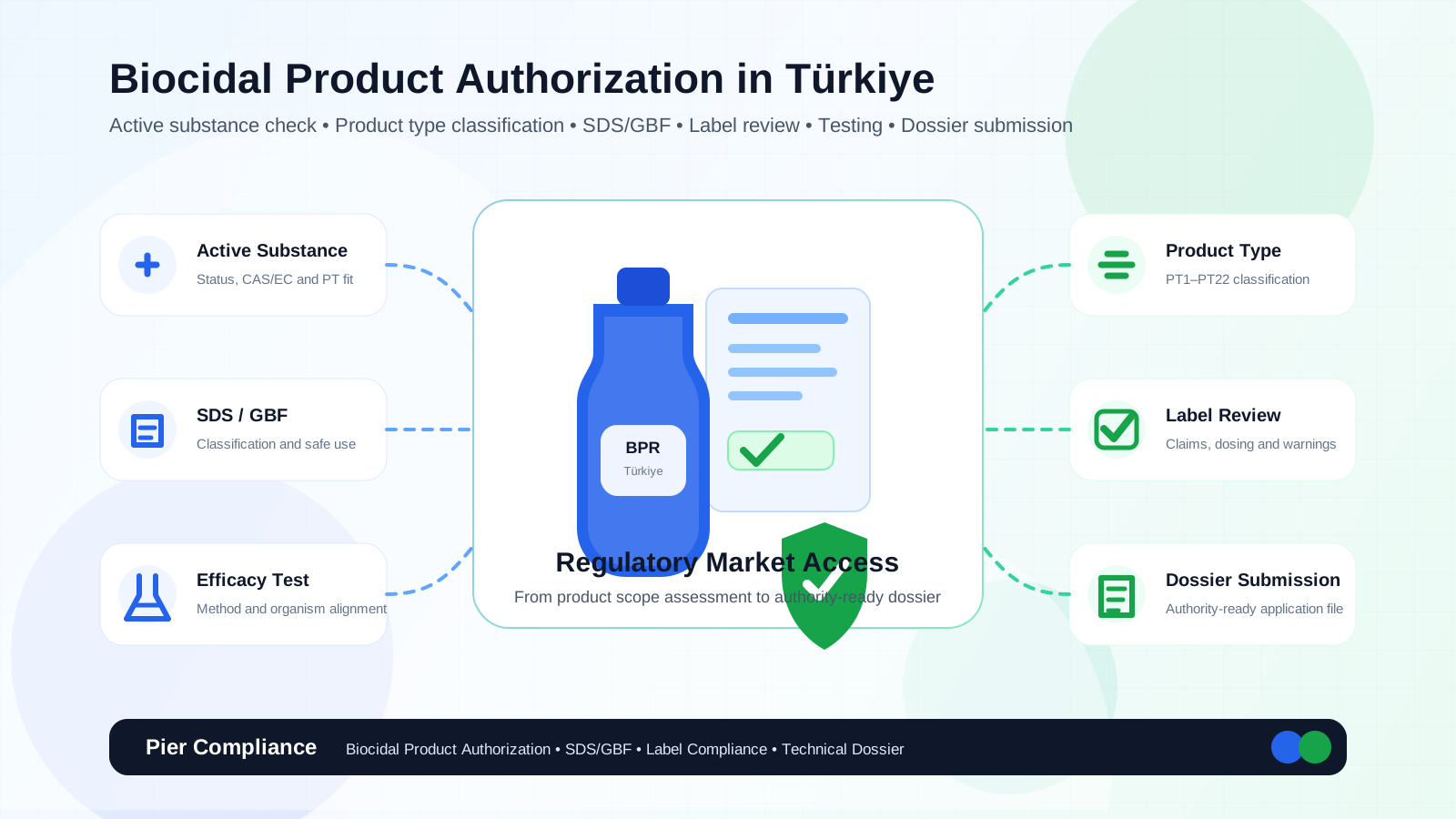
What: biocidal product authorization in Türkiye covers active substance checks, product type classification, efficacy testing, SDS review, label compliance and technical dossier preparation. Who: manufacturers, importers and brand owners placing disinfectants, preservatives or pest-control products on the Turkish market. Why: authorization gates Türkiye market access and reduces enforcement risk. How: scope assessment, test strategy, dossier build and authority follow-up.
Biocidal Product Authorization in Türkiye: A 2026 Guide to Compliance, Testing and Dossier Preparation
Biocidal product authorization in Türkiye (Turkey) is the regulatory pathway through which disinfectants, preservatives, pest-control products and other biocidal formulations must be assessed before they are placed on the market. The process sits under Ministry of Health oversight and is shaped by product type, active substance status, intended use and marketing claims—not by the formulation alone. For manufacturers, importers and brand owners, authorization is both a technical dossier exercise and a Türkiye market access decision that should be planned early.
This guide explains what a biocidal product is, how the Turkish framework relates to EU BPR, which tests and documents authorities typically expect, and how to reduce rework across SDS, labelling and the technical file. Requirements vary depending on the product type, active substance status, product claims and intended use.
What is a biocidal product?
A biocidal product is a formulation intended to destroy, deter, render harmless or control harmful organisms through chemical or biological action. Typical examples include hand and surface disinfectants, wood preservatives, insecticides and water-treatment biocides. Whether a product falls within biocidal scope depends on its claims, use setting and product type (PT) classification—not only on whether it contains an active substance.
Short answer: A biocidal product is a product intended to destroy, deter, render harmless or control harmful organisms through chemical or biological action. In Türkiye, the regulatory status depends not only on the formulation, but also on the product claims, intended use and product type.
Why biocidal product authorization matters in Türkiye
Placing a biocidal product on the Turkish market without the appropriate authorization route creates commercial and compliance risk. Authorities evaluate whether the active substance is acceptable for the claimed use, whether efficacy data supports label statements, and whether SDS and labelling communicate safe use clearly. For supply-chain teams, authorization status also affects import planning, distributor agreements and retail listings.
Short answer: Biocidal product authorization in Türkiye covers active substance checks, product type classification, testing requirements, SDS review, label compliance, technical dossier preparation and authority follow-up.
Authorization should be treated as a cross-functional programme linking regulatory affairs, quality, R&D, labelling and commercial teams—not as a last-step filing task.
The relationship between Türkiye BPR and EU BPR
Türkiye's biocidal product framework is broadly aligned with the EU Biocidal Products Regulation (BPR). Similar concepts—product types, active substance lists, efficacy expectations and risk assessment logic—often appear in both systems. However, EU authorization or assessment does not automatically transfer to Türkiye. Active substance status, dossier content, labelling language and the local application structure must be reviewed for the Turkish market separately.
Companies with EU portfolios should use EU BPR progress as a planning input, not as a substitute for Türkiye-specific gap analysis. Where substance review cycles or label templates differ, the Turkish file may need additional justification, testing or formatting work.
Biocidal product types
Biocidal products are grouped into four main categories, each containing multiple product types (PTs):
| Main group | Typical scope |
|---|---|
| Main group 1: Disinfectants | Human hygiene, surface, veterinary and food-area disinfection |
| Main group 2: Preservatives | In-can, film, fibre, leather, wood and material preservation |
| Main group 3: Pest control | Insecticides, rodenticides, repellents and related products |
| Main group 4: Other biocidal products | Niche or specialised biocidal uses outside the first three groups |
Correct product type classification determines the test package, exposure assumptions and dossier structure. Misclassification at this stage is one of the most expensive errors to fix later.
PT1 to PT5: what changes in practice
PT1 — Human hygiene disinfectants: Used on skin or hands. Efficacy must match the target organisms claimed on the label, with realistic contact time and application instructions. Human exposure scenarios weigh heavily in the file.
PT2 — Disinfectants and algaecides not covered by PT1: Surface, equipment and environmental disinfection products fall here. Test design should reflect the stated use area, soiling level and contact time—not a generic laboratory protocol.
PT3 — Veterinary hygiene: Products used in animal housing, veterinary premises or related settings. Target organisms, application surfaces and user profile differ from PT1/PT2 and should be reflected consistently in tests and labelling.
PT4 — Food and feed area disinfectants: Products used where food contact or food-processing hygiene is relevant. Efficacy, residue thinking and label warnings need tighter alignment with the intended food-area use.
PT5 — Drinking-water disinfectants: Performance and safety expectations relate to water-treatment use. Dose, contact time, target organisms and user instructions must read as one coherent story across the dossier, SDS and label.
For each PT, the link between target organism, contact time, concentration, use instruction and label claim is central. Authorities typically look for that chain to be visible from test report to market-facing materials.
Active substance checks
Before building a dossier, confirm whether each active substance is acceptable for the intended product type in Türkiye. Active substance status—approved, under review, restricted or otherwise limited—shapes whether authorization is feasible and on what timeline. This step also affects formulation strategy: substituting actives late in the project can invalidate completed tests.
Active substance review should be linked to supplier traceability, CAS/EC identity and any co-formulant of regulatory concern. Where KKDIK or broader chemical compliance overlaps apply, coordinate early with your chemical regulatory compliance programme so data and classifications stay consistent across files.
Biocidal authorization step by step
1. Pre-assessment and scope analysis
Start by confirming the product is biocidal in scope, identifying the correct PT, and mapping the commercial claims you intend to use. This step defines the authorization strategy, timeline and budget. It also clarifies whether the product is manufactured locally or imported, which affects the responsible-party structure.
2. Active substance and formulation review
Review the full formulation against active substance status and PT boundaries. Document sourcing, purity/specification logic and any substances that may trigger additional scrutiny. Formulation consistency underpins both risk assessment and later audit defence.
3. Defining required analyses and tests
Based on PT, claims and formulation, define physicochemical, stability and efficacy testing needs. Avoid copying a test list from an EU file without checking whether method, organism panel and use scenario fit Turkish expectations. A test plan created at this stage reduces duplicate laboratory work.
4. SDS and SEA/CLP classification review
The SDS must reflect the product's hazard profile and support safe use. Classification and labelling should be coherent with SEA/CLP expectations where applicable. Review SDS content together with draft label elements before locking the dossier narrative. For execution support, see SDS preparation and the SEA notification via KKS guide.
5. Label and packaging compliance
Labels carry legal claims, pictograms, safety phrases, batch traceability and use instructions. Every performance statement should be traceable to test evidence. Packaging format, child-resistant features or language requirements may also matter depending on the product type and sales channel.
6. Technical dossier preparation
The technical dossier consolidates formulation rationale, manufacturing/import details, test reports, SDS, labelling, risk assessment elements and administrative documents. Weak dossiers often fail not because the product is unsuitable, but because the file does not explain why the evidence supports the proposed use and claims.
7. Application, follow-up and authority communication
Submit through the applicable Ministry of Health workflow and monitor completeness and information requests. Response quality and turnaround time materially affect approval timing. Structured follow-up is part of authorization—not an afterthought.
Testing and analysis requirements
Biocidal authorization typically draws on a layered testing package, including:
- Physicochemical tests
- Short-term stability tests
- Long-term stability tests
- Opened-package stability, where relevant
- Efficacy tests
- Microbiological efficacy studies
- Product-type-specific performance tests
Tests should align with the product type, target organism, use instruction, contact time, concentration and label claims. A report that uses the wrong organism panel or an unrealistic contact time may be technically well executed but still unusable in the dossier. Stability data should reflect the commercial packaging and storage claims you intend to make.
SDS and classification control
The SDS is a core compliance document for biocidal products. It communicates hazards, handling conditions, emergency measures and regulatory classification logic to users and inspectors. In Türkiye, SDS content should be consistent with SEA/CLP classification outcomes and with the product label.
Common failure points include mismatched hazard statements between SDS and label, outdated classifications after formula changes, and exposure language that does not reflect real use settings. A dossier-ready SDS is one that matches the authorization story—not a standalone translation of a foreign document.
Label and packaging compliance
The label is the most visible part of the authorization package. It states what the product does, how it should be used, which organisms are targeted, how long contact must be maintained, and which safety warnings apply. Inspectors and customers often compare the label directly with efficacy reports.
Packaging review should cover language requirements, claim wording, pictogram use, batch coding and any sector-specific retail rules. Marketing teams and regulatory teams should work from one approved claim set to avoid post-approval relabelling costs.
Local responsible party requirements for imported products
Imported biocidal products generally require a clear local application structure in Türkiye. Foreign manufacturers should not assume that an EU authorization holder can automatically act as the Turkish applicant without a defined local arrangement. The responsible party model affects who submits the file, responds to authority requests and maintains post-authorization obligations.
Short answer: A biocidal product authorized or assessed in the EU should not be assumed to be automatically marketable in Türkiye. The active substance status, product type, label, SDS and local application structure should be assessed for the Turkish market.
Plan import structure, document control and communication lines before commercial launch. Where needed, align with biocidal product authorization support early in the supply-chain design.
Most common mistakes
- Misidentifying whether the product falls within biocidal scope
- Checking active substance status incompletely or too late
- Selecting the wrong product type
- Running efficacy tests that do not match target organisms or claims
- Inconsistency between SDS and label information
- Using label claims not supported by technical data
- Mismatch between formulation records and analytical reports
- Weak justification in the technical dossier
- Failing to establish a clear local responsible-party structure for imports
Each of these issues can add months of delay. Most are preventable with structured pre-assessment.
Pier Compliance biocidal authorization services
Pier Compliance supports biocidal product authorization in Türkiye with a practical, dossier-focused approach:
- Biocidal product scope assessment
- Product type classification
- Active substance list/status check
- Formulation review
- Testing and analysis requirement mapping
- Laboratory coordination
- Efficacy test strategy
- SDS preparation and review
- SEA/CLP classification review
- Label and packaging compliance check
- Technical dossier preparation
- Application file structuring
- Response support for authority information requests
- Türkiye market access strategy for imported biocidal products
- Local representative / responsible party support where applicable
Our role is to connect regulatory requirements with operational reality so your file remains defensible under review. Explore our biocidal product authorization service for scope details, or browse frequently asked questions for related compliance topics.
Türkiye market entry checklist
Before launch, confirm the following:
- The product carries biocidal claims or falls within biocidal scope
- Active substance status has been verified for the intended PT
- The correct product type has been selected
- Existing test reports have been assessed for Türkiye suitability
- SDS and label content are aligned
- The applicant or local responsible-party structure in Türkiye is defined
- Authorization timing is built into the commercial launch plan
Key control areas in biocidal product authorization
| Control area | Why it matters | Pier Compliance support |
|---|---|---|
| Active substance check | Defines the authorization strategy | List and PT alignment review |
| Product type classification | Shapes testing and dossier scope | PT classification |
| Efficacy tests | Supports label claims | Test strategy and laboratory coordination |
| SDS | Required for safe use and classification | Regulatory SDS preparation |
| Label review | Reduces market and inspection risk | Label and packaging compliance review |
| Technical dossier | Foundation of authority assessment | Dossier preparation and authority communication |
Conclusion
Biocidal product authorization in Türkiye is a structured process that connects active substance status, product type logic, laboratory evidence, SDS quality, labelling accuracy and dossier coherence. Teams that treat it as a launch-critical programme—rather than a late regulatory formality—typically move faster and face fewer surprises during authority review.
If you are planning to place a biocidal product on the Turkish market, Pier Compliance can help you assess the scope, testing needs, labelling requirements and authorization strategy. Contact Pier Compliance to discuss your product and next steps.
Frequently asked questions
- Can a biocidal product be sold in Türkiye without authorization?
- A product carrying biocidal claims should be assessed under the applicable Turkish biocidal product requirements before being placed on the market. The need for authorization or another compliance route depends on the product scope, active substance status, product type and intended claims.
- Are disinfectant products considered biocidal products?
- Yes. Products intended for human hygiene, surface disinfection, veterinary hygiene or food-area disinfection may fall within the biocidal product framework. The correct product type and intended use should be assessed before market placement.
- Can tests performed outside Türkiye be used for a Turkish application?
- In some cases, tests performed outside Türkiye may be considered. However, the test method, laboratory competence, report content, product type and alignment with Turkish requirements should be reviewed.
- Why is the biocidal product label important?
- The label defines the product's claims, instructions for use, contact time, target organisms and safety warnings. Label claims should be supported by the test reports and technical dossier.
- How can foreign manufacturers manage biocidal authorization in Türkiye?
- Foreign manufacturers should assess the Turkish market requirements separately, even if the product has been evaluated in the EU. The active substance status, product type, SDS, label and local application structure should be reviewed.
- How does Pier Compliance support biocidal product authorization?
- Pier Compliance supports scope assessment, active substance checks, product type classification, testing strategy, SDS review, label compliance, technical dossier preparation and application follow-up for biocidal products in Türkiye.
Related Posts
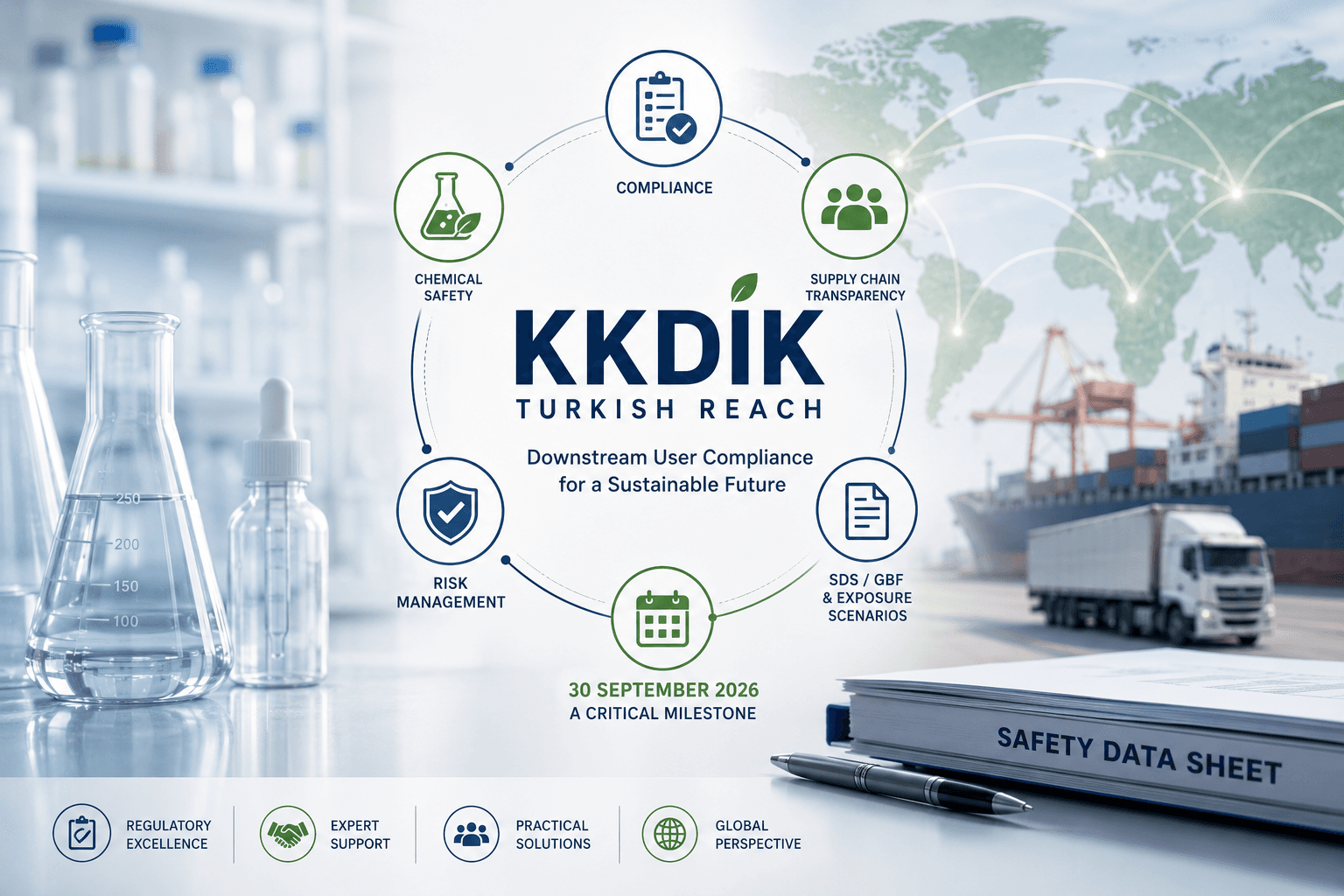
KKDIK Downstream Users: What You Need to Know Before 30 September 2026
Before the 30 September 2026 KKDIK interim registration milestone, downstream users should review use notification, SDS alignment, exposure scenarios and supply-chain roles. Pier Compliance supports role mapping and Chemical Assessment Specialist–approved SDS.

What Is an SDS (Safety Data Sheet) and Who Prepares It in Turkey?
A corporate guide to Safety Data Sheets for Türkiye: legal role, operational impact, KKDIK and SEA alignment, and why a Chemical Assessment Specialist is central to defensible SDS quality.

KKDİK Individual Interim Registration 2026: KKS Process, KDU, Official Fee and the Lead Registration Option
How the Ministry is steering KKDİK firms toward KKS individual interim registration: pre-MBDF checks, KDU input, official fee planning, and why the lead/consortium path remains open.