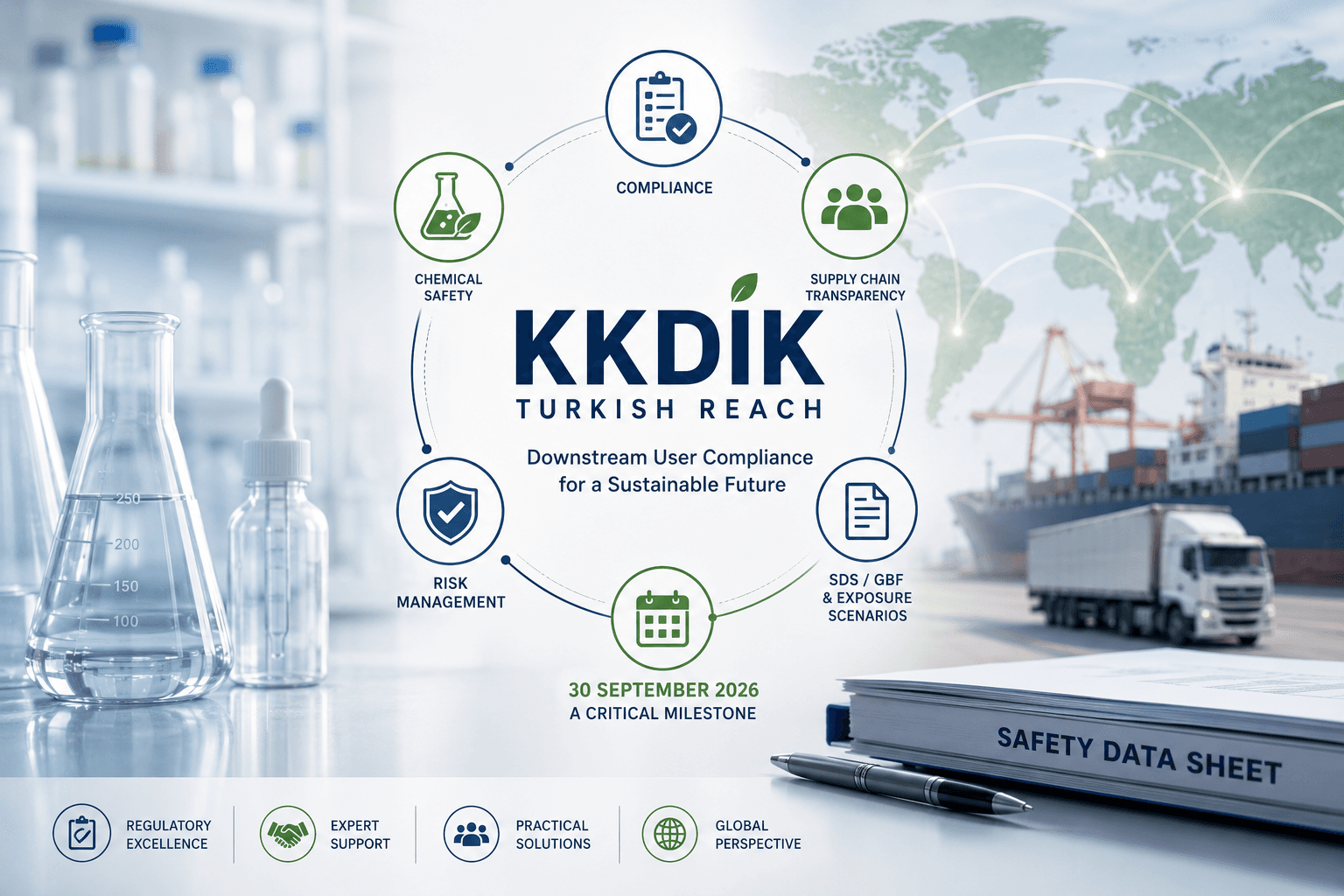
Turkey’s chemicals regime (KKDIK / Turkish REACH) applies across the full supply chain—not only to manufacturers and importers. Downstream users are often treated as passive recipients of compliance work, yet they carry responsibility for use information, SDS discipline, exposure scenarios and risk management measures (RMMs) on site.
30 September 2026 is a defining date for interim (provisional) registration where substances are supplied to the Turkish market at one tonne per year or more (unless exempt). For downstream users, it is the moment to check whether supplier files, supported uses and your day-to-day operations still match.
Introduction
KKDIK assigns distinct duties to economic operators. Downstream user status depends on what you actually do, not how your entity is labelled in contracts: one site in a group may import, another may only consume.
When interim registration activity intensifies, weak information flow between registrant, importer and downstream user can leave gaps between the technical dossier and field practice. That gap shows up in audits and customer questionnaires.
This article complements our KKDIK services and the provisional interim registration deadline guidance from a downstream-user angle.
In multi-site groups, import and in-process use may coexist under one corporate name. Role mapping should be clarified per site or production line. Procurement may assume “registration is done” while technical teams and occupational health apply different realities. An internal alignment meeting before 30 September 2026 helps connect those workstreams.
What is a downstream user?
Under KKDIK Article 4(1)(b), a downstream user uses a substance or mixture in their own activities and does not place that substance or mixture on the market.
| Actor | Short description |
|---|---|
| Manufacturer | Produces and places a substance on the market in Türkiye |
| Importer | Imports and places a substance on the market |
| Distributor | Stores/transports and places substance/mixture on the market |
| Downstream user | Uses in own process; does not supply onward |
A formulator prepares mixtures; if you sell those mixtures onward, your role changes. Role = activity, not job title.
Why 30 September 2026 matters
30 September 2026 is the widely referenced milestone for individual interim (provisional) registration for in-scope substances on the Turkish market at ≥1 t/year, absent exemption. Downstream users may not file registrations themselves, but they should answer:
- Does the supplier’s KKS registration and use coverage include your actual use?
- Could tonnage or supply activity make you an importer in practice?
- Is there a clear path from interim registration to full KKDIK registration across the chain?
How Turkish importers and downstream users are reflected in the supplier dossier helps ensure supported uses match site practice. Leaving coordination to the final weeks compresses internal approvals and supplier response times.
Through KKS, interim registration workflows often require supplier confirmation, use summaries and SDS revision dates. In customer or audit dialogue, a registration reference alone may be insufficient; written confirmation that your use is supported in the file strengthens your position.
If the same substance appears as a mixture component and in a finished product, review tonnage aggregation and role mapping together. Pre-MBDF activity alone does not replace a defensible interim path; read it alongside data-sharing and consortium strategy.
Core risk areas
Typical downstream-user exposure includes:
- Drift toward importer status — import and tonnage together can trigger importer duties.
- Unsupported use — if your use is absent from the registration file, further assessment and Article 30 dialogue are likely.
- SDS / exposure scenario mismatch — labels, operating conditions and scenarios may not reflect the workplace.
- Non-implementable RMMs — operational limits require structured feedback upstream.
- Missing Chemical Assessment Specialist–approved SDS — customer and EHS audits increasingly request robust documentation (SDS service).
- Missed 6- or 12-month timelines — Articles 34 and 35 notification and implementation windows.
- Article producers — SVHC awareness and Article 29 information requests from suppliers.
If supply-chain documentation is incomplete, you will be weak in audits and customer reviews; refresh inventory and supplier mapping early.
Professional versus industrial downstream use changes exposure profiles and which SDS sections must reach the workplace. Cleaning, maintenance or on-site service providers should track whether measures at client premises remain consistent with the SDS. Article producers may need Article 29-level supplier information on SVHC or release scenarios—response timelines can affect production planning.
Contract clauses between importer and downstream user clarify who manages registration in practice, but statutory duties are not transferred by agreement alone. Compliance responsibility still follows activity.
Role transitions table
| Role | Activity | KKDIK focus |
|---|---|---|
| Formulator | Mixture or product formulation | Component registration status, SDS currency, supported use |
| Industrial downstream user | Use in manufacturing | Exposure scenario scaling, on-site RMMs, Article 30 feedback |
| Professional downstream user | Use in commercial services (e.g. cleaning) | Measures at client premises, SDS communication to end users |
| Re-filler | Repackaging / change of container | Preserving original SDS and label data, new pack size |
| Article producer | Substance in article or release | SVHC information, supplier requests under Articles 29/30 |
| Distributor / brand owner | Storage–distribution, branded supply | Not placing on market vs import line, label responsibilities |
Practical checklist
Before 30 September 2026, downstream users can work through:
- Substance and mixture inventory (CAS, trade name, supplier)
- Supplier and importer map for the Turkish supply line
- Annual tonnage and use analysis
- SDS currency and language fit
- Exposure scenario vs on-site conditions
- Chemical Assessment Specialist approval status
- Use notification and supported-use confirmation
- Feasibility of risk management measures
- Supplier confirmation of interim registration / KKS status
- Role analysis if needed (Only Representative guide)
Maintain a per-substance documentation pack: latest SDS, supplier supported-use confirmation, internal use description, evidence of on-site RMMs, and Article 30 correspondence. This speeds up customer questionnaires and interim-registration due diligence. For mixtures, archive SDS for key component substances—not only the finished mixture SDS.
Exposure scenarios and scaling
An exposure scenario attached to the registration communicates use conditions and risk management measures relevant to downstream users. Scaling compares your real operating parameters (ventilation, duration, amounts) with scenario assumptions.
Not every difference automatically means non-compliance; however, technical assessment is required.
In some cases a downstream user chemical safety report may need to be prepared or completed. This is use- and tonnage-dependent—not a blanket obligation for all downstream users.
Typical scaling steps: (1) read scenario and use conditions in the SDS annex, (2) collect site ventilation, duration and quantity data, (3) document deviations, (4) where meaningful, provide structured Article 30 feedback to the supplier. This is technical communication, not an automatic penalty trigger.
Where mixture and substance suppliers provide different scenarios, review each component in your formulation separately. Relying on one “main supplier” generalisation is a common formulator mistake.
Articles 30, 34 and 35
Article 30 — Upstream communication
New hazard information, uses not covered in the SDS, or inability to apply RMMs should be communicated upstream to the supplier. Keep records of that dialogue. Common triggers: changed process parameters, new wastewater or waste profile, PPE not foreseen in the scenario, or a changed mixture composition. A factual email with CAS number, use code (if any) and a short description of the deviation speeds the registrant’s response.
Article 34 — Notification and 6-month period
Certain situations may involve notification to the Ministry and a six-month window. Triggers depend on the case; replace generic statements with situation-specific review.
Article 35 — Implementation and 12-month period
A twelve-month framework may apply to implementing RMMs or completing necessary assessments. Aligning operational planning with regulatory timelines reduces friction.
How Pier Compliance can help
Downstream users benefit most when a clear role matrix is agreed before the registrant finalises interim dossier content. We help translate operational data into use descriptions for supplier dialogue and prioritise high business-risk substances (sole source, significant Turkey tonnage, critical formulations).
We support KKDIK and Turkish REACH programmes with:
- KKDIK role analysis and supply-chain mapping
- KKS / dossier strategy and interim registration planning
- Only Representative coordination in Türkiye
- Interim (provisional) registration preparation and supplier alignment
- Chemical Assessment Specialist–approved SDS preparation
- SDS and exposure scenario reviews
- Use notification and Article 30 supplier communication
- Chemical safety and RMM assessments
See our KKDIK service page or contact us for a structured discussion.
Conclusion
Treat 30 September 2026 as a supply-chain compliance date, not only a registrant deadline. Reviewing inventory, supplier positions and SDS packages now reduces pressure in the final weeks.
Pier Compliance provides end-to-end support on KKDIK and Turkish REACH role analysis, Chemical Assessment Specialist–approved SDS, Only Representative management and interim registration strategy.
Frequently asked questions
- Who is a downstream user under KKDIK?
- Under Article 4(1)(b), a downstream user uses a substance or mixture in their own activities but does not place that substance or mixture on the market. The role follows actual activity, not the company title on paper.
- Why does 30 September 2026 matter for downstream users?
- It is a key milestone for individual interim (provisional) registration for in-scope substances supplied to the Turkish market at one tonne per year or more, unless exempt. Even when you are not the registrant, supplier dossiers, supported uses and import positioning can create obligations.
- Must downstream users register under KKDIK?
- Registration is not automatic for every downstream user. If you import, exceed tonnage thresholds or your role shifts, obligations may be reassessed. Alignment with your supplier’s registration file is essential.
- Why are SDS and exposure scenarios important?
- The safety data sheet (SDS) is the main channel for classification, handling conditions and exposure scenarios. Outdated or inconsistent SDS content makes it harder to implement risk management measures and may require supplier communication under Article 30.
- What if my use is not supported in the supplier registration?
- Clarify your use profile and contact the supplier under Article 30. Unsupported uses may require additional assessment, use notification or supply alternatives; early action helps manage timelines.
- Why is a Chemical Assessment Specialist–approved SDS relevant?
- Review by a Chemical Assessment Specialist strengthens technical consistency and regulatory alignment of the SDS. Customer audits and occupational health processes increasingly expect this level of documentation.
- How can Pier Compliance support?
- We help with KKDIK role analysis, supply-chain mapping, KKS dossier strategy, Only Representative coordination, interim registration planning, SDS preparation and exposure scenario checks. Reach us via our [contact page](/en/contact).
Related Posts
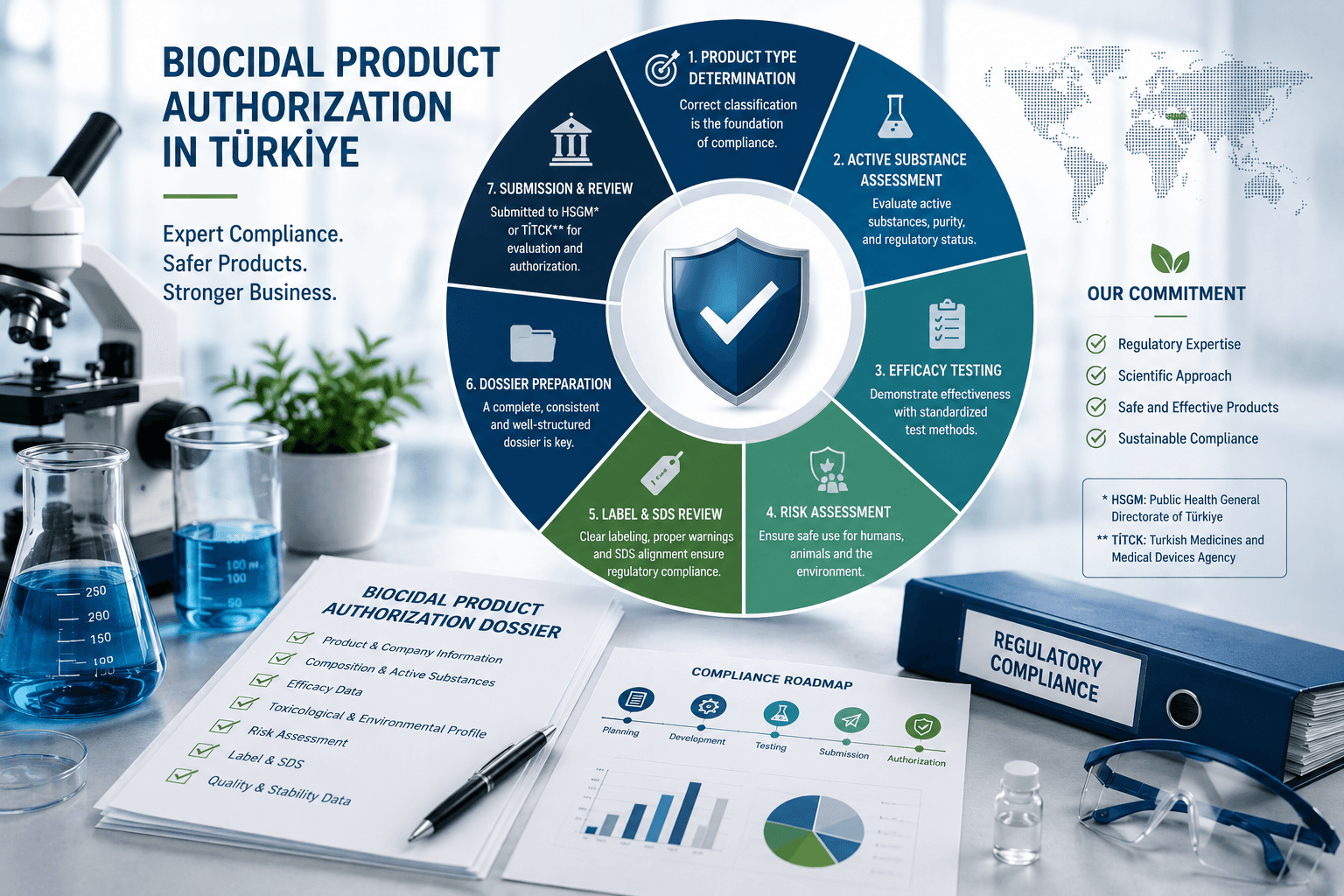
Biocidal Product Authorization in Türkiye: Technical Dossier, Active Substance and Market Access Strategy
Biocidal product authorization in Türkiye requires product-type assessment, active substance review, efficacy data, label claim control, risk assessment and a technically consistent authorization dossier.
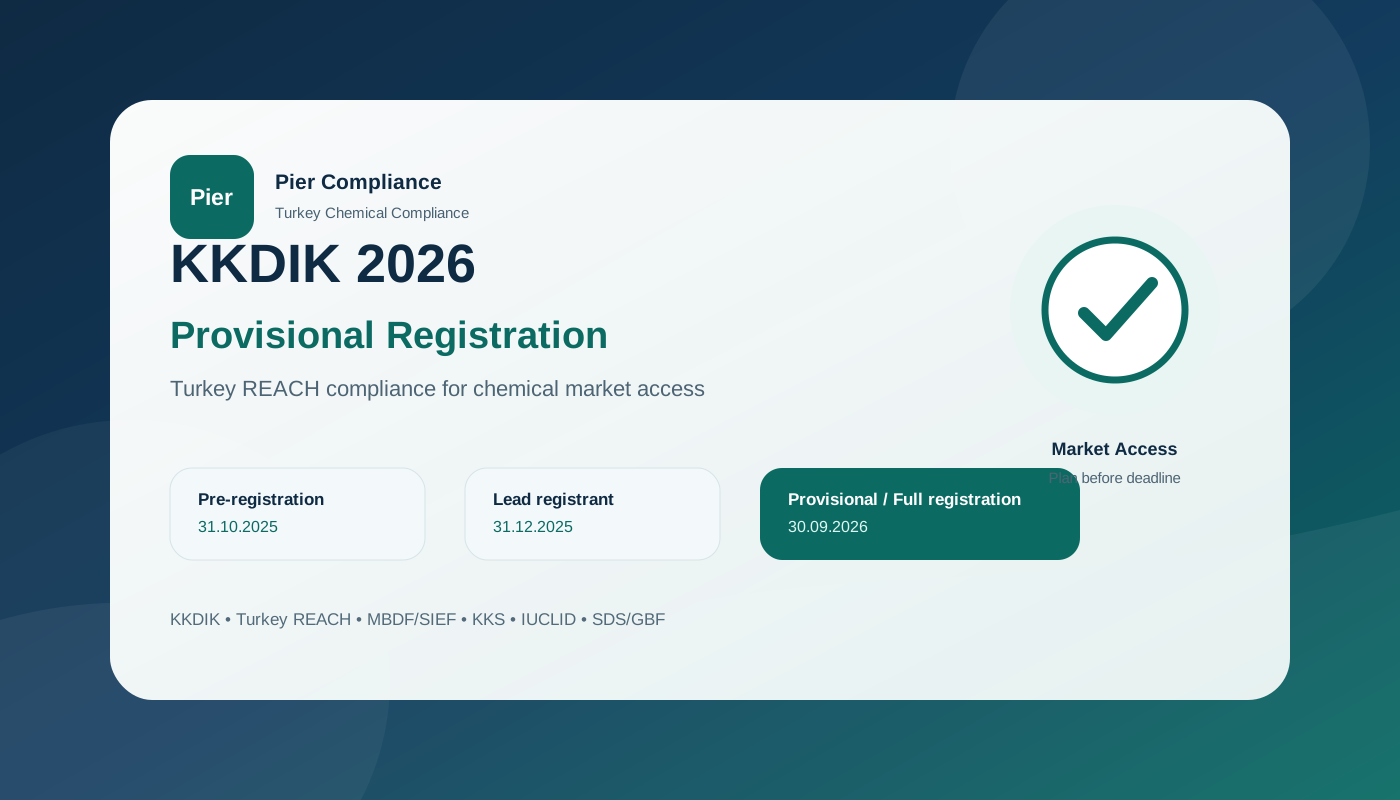
KKDIK Registration and Consulting Services 2026: Provisional Registration, Individual Filing and Turkey REACH Compliance
Pier Compliance supports companies with KKDIK 2026 pre-registration, MBDF/SIEF, lead and co-registration, individual provisional registration, full registration, KKS and IUCLID dossiers.
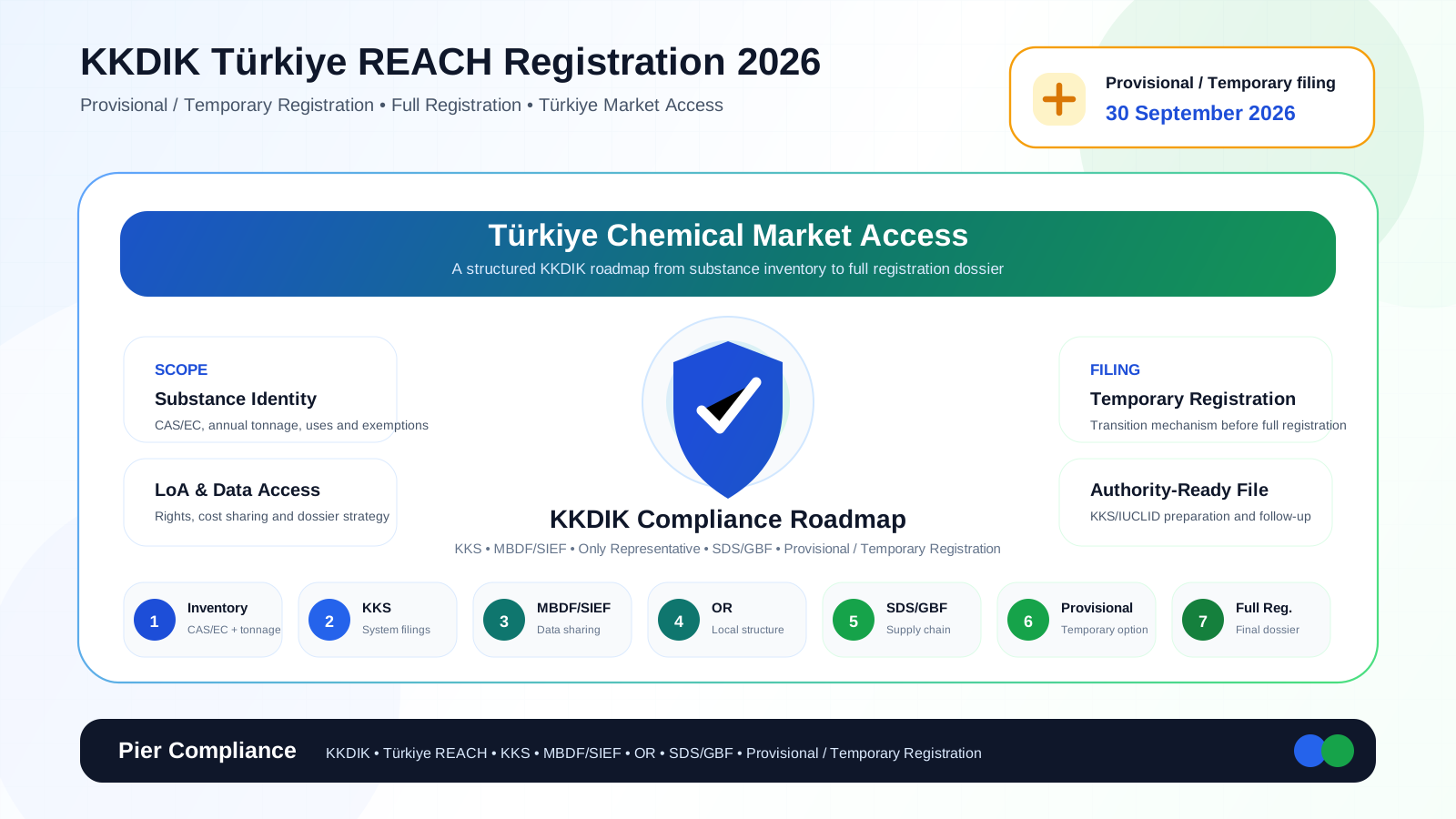
KKDIK Türkiye REACH Registration Guide 2026: Provisional / Temporary Registration, Full Registration and Market Access
A practical guide to KKDIK Türkiye REACH registration, the 30 September 2026 provisional / temporary registration deadline, Only Representative services, MBDF/SIEF, SDS, LoA and full registration strategy.