

A REACH Registration Is Not Just a Number: Only Representative Governance and Audit Readiness
Executive answer: No. Holding a REACH registration number does not mean every product, mixture, article, importer or customer use is covered for EEA shipments. Coverage must be verified through the represented manufacturer, substance identity, composition, tonnage band, covered importers, registered uses, valid data rights and a current IUCLID dossier. A registration number is an identifier inside a system — not a certificate of total compliance.
For the fundamentals of EU REACH registration and the Only Representative (OR) model, start with our introductory EU REACH / Only Representative guide. This advanced guide focuses on governance: how to keep that registration defensible after the number exists.
Last technical review: August 2026.
Table of contents
- Why a REACH registration is a regulatory asset
- Seven control layers of a defensible REACH system
- Only Representative change and registration transfer
- Audit-ready REACH Regulatory Data Room
- Red flags in weak OR models
- Pier Compliance REACH Governance Framework
- Decision table
- Key takeaways
- Official sources
- Conclusion and next steps
Why a REACH registration is a regulatory asset
Short answer: A registration number proves that a dossier was submitted and accepted in a defined context. It does not, by itself, prove that today’s shipments, legal entities, compositions or uses still match that context.
Under Regulation (EC) No 1907/2006 (REACH), registration links market access to a living file: substance identity, tonnage, uses, classification, chemical safety conclusions and company-specific data. That file connects to SDS/eSDS, customer questionnaires, importer coverage and enforcement questions.
Treat the registration as a regulatory asset with owners, change control and evidence — not as a one-off PDF or “REACH certificate”.
Separate regimes (keep them distinct)
| Regime | Market |
|---|---|
| EU REACH | EEA (EU + Iceland, Liechtenstein, Norway) |
| UK REACH | Great Britain — separate system |
| KKDIK | Türkiye — separate registration system |
Registration in one regime does not automatically satisfy the others. Technical data can often be reused carefully; legal status cannot. Related reading: KKDIK services (separate from EU REACH).
Seven control layers of a defensible REACH system
1. Legal entity and supply-chain architecture
Short answer: Identify the real non-EEA manufacturer, every EEA importer that must be covered, and whether group companies are distinct entities that need separated registration logic.
Map:
- Actual manufacturer vs exporter or trading company
- Group companies and multiple plants
- Toll / contract manufacturing
- Indirect sales via distributors
- Correct EEA importer legal entities
Being in the same corporate group does not automatically create one non-EEA manufacturer. Where several non-EEA manufacturers are represented, ECHA’s OR account practice requires clear separation of manufacturer-related information.
An Only Representative must be established in the EEA and able to manage the practical obligations for the represented substances (ECHA — Only Representative). Pier Compliance supports the technical and operational management of OR programmes; appointment itself must run through an EEA-established legal person that meets Article 8 conditions.
2. Substance identity, analytics and sameness
Short answer: CAS/EC numbers are not enough. Sameness depends on composition, impurities, process context and alignment with co-registrants’ Substance Identity Profile where applicable.
Distinguish mono-constituent, multi-constituent and UVCB substances. Document purity/impurity profiles, stabilisers and process-driven variability. Build or verify a Substance Identity Profile (SIP) and boundary composition where relevant (substance identification; sameness).
A Certificate of Analysis supports batch release; it is not automatically a REACH identity package. Analytical methods (for example GC/GC-MS, HPLC/LC-MS, FTIR, NMR, ICP, XRD) should be selected according to the substance, then interpreted into IUCLID Section 1 — not dumped as unreviewed attachments.
3. Data sharing, Letter of Access and data rights
Short answer: An LoA is usually a right to refer to data, not ownership of the studies. Scope, future costs and transferability must be explicit.
Review:
- Right to refer vs data ownership
- Tonnage-band coverage
- CSR / Chemical Safety Report access
- Future study and tonnage-upgrade fees
- Consortium / administration fees
- Refund mechanisms
- Transfer rights on OR or legal-entity change
- Whether group affiliates are covered
Data sharing should remain fair, transparent and non-discriminatory (working together / data sharing). Unnecessary cost items should be challenged on technical grounds. Where contracts need legal opinion, engage counsel; Pier Compliance provides technical and regulatory review of LoA packages, not law-firm advocacy.
4. IUCLID dossier engineering and quality control
Short answer: IUCLID is an engineered dataset. Technical completeness ≠ scientific and regulatory adequacy.
Control Section 1 identity and composition, company-specific information, uses and tonnage, classification and labelling, jointly submitted vs member-specific fields, waiving and read-across justifications, endpoint study records / robust study summaries, CSR links and confidentiality claims (creating your registration dossier).
Run Validation Assistant, then expert review. Joint submission membership does not erase the member registrant’s duty for correct company-specific data.
5. Use, exposure and SDS integrity
Short answer: A registered substance does not automatically cover every customer use. IUCLID, CSR, eSDS and real uses must align.
Map use descriptors (Sector of Use, Product Category, Process Category, Environmental Release Category), industrial / professional / consumer patterns, Operational Conditions and Risk Management Measures. New customer uses can trigger dossier and SDS updates. Align SDS preparation with the registration narrative — not as a parallel silo.
6. Importer and tonnage governance
Short answer: Maintain a live inventory of covered importers and substance tonnage — not a year-end guess.
Track each covered importer, quantities imported, direct and indirect routes, substance content in mixtures, and aggregation across trade names. Compare total OR tonnage with the registered band. Plan early warnings before a band increase creates new information or LoA needs.
Illustrative example (not a real client case): Product A is a 40% substance mixture; 250 tonnes of mixture are imported via Importer 1 → 100 t substance. Product B (same substance, 10%) ships 600 tonnes via Importer 2 → 60 t. Combined OR substance tonnage = 160 t, which may sit in a different band than either product’s mixture tonnage suggests. Mixture tonnes ≠ substance tonnes.
7. Dossier lifecycle and enforcement readiness
Short answer: The dossier is a living document. Update triggers and deadlines vary by change type (keeping your dossier up to date; update deadlines).
Typical triggers: company data changes, composition or process changes, new uses, new hazard information, classification changes, tonnage-band changes, CSR updates, ECHA evaluation decisions and joint-submission updates. Do not invent a single universal deadline for all events.
Build a controlled record set you can present to authorities or customers without reconstructing history under pressure.
Only Representative change and registration transfer
Short answer: Changing OR is a migration programme. Signing a new appointment letter is only one step.
Plan for:
- REACH-IT assets and legal-entity change mechanics
- IUCLID datasets and submission reports
- ECHA correspondence history
- LoA / consortium rights (often separate from registration transfer)
- Historical tonnage and covered-importer lists
- Ongoing evaluations
- Cut-over calendar so no coverage gap appears between outgoing and incoming OR
Registration transfer and data-use rights must be assessed separately. Some LoA terms travel with the registration; others do not.
Audit-ready REACH Regulatory Data Room
A practical Pier Compliance deliverable is a controlled REACH Regulatory Data Room — structured evidence, not a random email archive:
- OR appointment and legal-entity documents
- Registration and submission artefacts
- IUCLID datasets
- Substance identity and analytical reports
- Sameness assessment
- LoA and data-sharing documents
- Importer coverage registers
- Annual tonnage ledger
- SDS / exposure scenarios
- ECHA and lead-registrant correspondence
- Dossier update decision log
- Change-management records
Red flags in weak OR models
- Only a generic “REACH certificate” is provided
- Represented manufacturer is unclear
- No covered-importer list is maintained
- Tonnage is not calculated at substance level
- Composition / analytics never reviewed
- CAS number treated as sole scope proof
- No client access to IUCLID content
- LoA rights are undefined
- No OR change procedure exists
- ECHA correspondence is withheld from the client
- No SDS–dossier consistency check
- Passive mailbox/address model with no substance management
Pier Compliance REACH Governance Framework
Pier Compliance positions REACH work as programme governance — strategy, identity, data rights, IUCLID quality, importer control and evaluation readiness — not as a one-off document drop. We do not claim guaranteed registration, zero risk or “best in market” status. Authority comes from method and deliverables.
| Stage | Purpose | Typical outputs |
|---|---|---|
| 1. REACH Portfolio Intelligence | Prioritise substances and markets | REACH Portfolio Risk Matrix |
| 2. Legal Entity & Supply Chain Mapping | Clarify manufacturers, exporters, importers | Legal Entity and Supply Chain Map |
| 3. Substance Identity & Analytical Assessment | Build defensible identity | Substance Identity Assessment Memorandum |
| 4. Sameness & Joint Submission Assessment | Align with co-registrants | Sameness Assessment |
| 5. Data Gap & Registration Strategy | Choose inquiry / LoA / testing path | Data Gap Analysis; Registration Strategy Report |
| 6. Data Sharing & LoA Review | Clarify rights and cost drivers | Data Rights and LoA Review |
| 7. IUCLID Dossier Engineering | Submission-ready, reviewed dataset | Submission-Ready IUCLID Dossier |
| 8. Importer & Tonnage Governance | Live coverage controls | Importer Coverage Register; Annual Tonnage Ledger |
| 9. Post-Registration Change Control | Keep the asset current | Dossier Update Register |
| 10. Evaluation & Enforcement Readiness | Defend under scrutiny | REACH Regulatory Data Room; Annual REACH Governance Report |
For service scope, see EU REACH compliance.
Decision table
| Control area | Question to ask | Risk if missing | Evidence needed | Pier Compliance support |
|---|---|---|---|---|
| Legal entity | Who is the represented non-EEA manufacturer? | Wrong registrant logic | Appointment, org chart, plant list | Entity & supply-chain map |
| Substance identity | What is actually placed on the market? | Scope mismatch | Analytics, SIP, IUCLID §1 | Identity assessment |
| Sameness | Do we fit the joint-submission boundary? | Rejection / dispute | SIP, boundary composition | Sameness assessment |
| LoA / data rights | What can we refer to, at which tonnage? | Invalid dossier / cost shock | LoA, cost sharing terms | Data-rights review |
| IUCLID | Is the dataset engineered and consistent? | Incomplete / weak dossier | IUCLID export, QA checklist | Dossier engineering |
| Use coverage | Are customer uses registered? | Downstream failure | Use map, CSR/eSDS | Use & SDS alignment |
| Importers | Who is covered today? | Uncovered imports | Coverage register | Importer governance |
| Tonnage | What is substance tonnage vs band? | Band breach | Tonnage ledger | Tonnage early-warning |
| SDS | Do SDS/eSDS match the dossier? | Customer / audit findings | SDS set, ES | SDS programme link |
| Updates | What changed since last submission? | Late update risk | Change log | Update register |
| OR transfer | Can we migrate without a gap? | Market interruption | Transfer checklist | Migration plan |
| Audit file | Can we produce evidence in days? | Enforcement exposure | Data Room index | Data Room build |
Key takeaways
- A registration number is not a universal coverage certificate.
- Legal entity and substance identity errors propagate into every later control.
- LoA rights ≠ data ownership; transferability must be checked on OR change.
- IUCLID technical completeness is necessary but not sufficient.
- Importer coverage and substance tonnage need continuous ledgers.
- Update deadlines depend on the type of change.
- Weak OR models fail audits even when a number exists.
- Governance turns registration into a defendable market-access asset.
Official sources
- ECHA — Only Representative
- EUR-Lex — Regulation (EC) No 1907/2006 (REACH)
- ECHA — Keeping your dossier up to date
- ECHA — Substance identification
- ECHA — Establishing substance sameness
- ECHA — Creating your registration dossier
- ECHA — Working together / data sharing
- ECHA — Only Representatives: one non-EU manufacturer per account (PDF)
- ECHA — Respect the deadlines for updating
- ECHA — Registration information requirements
Conclusion and next steps
Obtaining a REACH registration number is the starting point. The lasting value is converting that registration into a governed, updatable and auditable system that protects EEA market activity.
Pier Compliance can support:
- Review of current REACH registration coverage
- IUCLID dossier health check
- Assessment of the Only Representative operating model
- OR transfer and migration planning
- Substance identity and sameness assessment
- LoA / data-rights review
- Importer and tonnage system design
- Enforcement readiness and Regulatory Data Room setup
We do not promise guaranteed registration, zero residual risk or universal coverage. Scope depends on substance facts, contracts and supply-chain design.
Ready to stress-test your REACH asset? Review EU REACH compliance, align SDS preparation, see references, and contact Pier Compliance · info@piercompliance.com.
Frequently asked questions
- Does a REACH registration number cover every shipment?
- No. Coverage depends on the represented non-EEA manufacturer, substance identity and composition, tonnage band, covered importers, registered uses, data rights and an up-to-date IUCLID dossier. A number alone is not a blanket market-access certificate.
- Can companies in the same group share one REACH registration automatically?
- No. Different legal entities are assessed separately. Being part of the same corporate group does not automatically make companies a single non-EEA manufacturer. Registration and account information must be separated where distinct manufacturers are represented.
- Is the same CAS number enough to prove the same substance?
- No. CAS or EC identifiers are starting points. Sameness requires composition, purity/impurity profile, manufacturing process context and, where relevant, a Substance Identity Profile (SIP) and boundary composition consistent with co-registrants.
- Is a Certificate of Analysis enough for substance identity?
- Usually not on its own. A CoA supports batch quality control; substance identity for REACH typically needs analytical characterisation appropriate to the substance type and an expert interpretation mapped into IUCLID Section 1.
- Does a Letter of Access mean we own the study data?
- No. An LoA typically grants a right to refer to data for registration purposes under defined conditions. Ownership, CSR access, future study costs, tonnage upgrades and transferability on OR change are contractual matters that must be reviewed separately.
- Must an Only Representative track importer tonnages?
- Yes. An OR should keep an up-to-date inventory of covered importers and quantities imported, so tonnage band compliance and covered-importer status remain defensible. Year-end reconciliation alone is a weak control model.
- Does joining a joint submission remove member responsibility?
- No. Membership in a joint submission does not remove the member registrant’s responsibility for company-specific information accuracy, covered uses, tonnage and updates under their own account.
- Can an Only Representative be changed?
- Yes, but change is an operational migration, not only a new contract. REACH-IT assets, IUCLID datasets, submission history, LoA rights, importer lists, tonnage records and open evaluations must be planned into a cut-over without coverage gaps.
- Does LoA transfer automatically when the OR changes?
- Not automatically. Registration transfer and data-use rights must be assessed separately against the LoA and consortium terms. Some rights are transferable; others require renegotiation or written confirmation.
- When must a REACH dossier be updated?
- When company data, composition, uses, classification, tonnage band, CSR conclusions or new hazard information change, and when ECHA or lead-registrant decisions require action. Deadlines depend on the type of change — there is no single universal update clock.
- Does IUCLID technical completeness prove full compliance?
- No. Validation Assistant and technical completeness checks help catch structural gaps. They do not replace scientific and regulatory judgement on identity, waiving, read-across, uses, CSR links and company-specific consistency.
- How does Pier Compliance support REACH governance?
- Pier Compliance supports technical and operational management of EU REACH Only Representative programmes: portfolio intelligence, substance identity and sameness assessment, LoA/data-rights review, IUCLID engineering, importer and tonnage governance, change control and audit-ready documentation. Contact info@piercompliance.com or /en/contact.
Related Posts
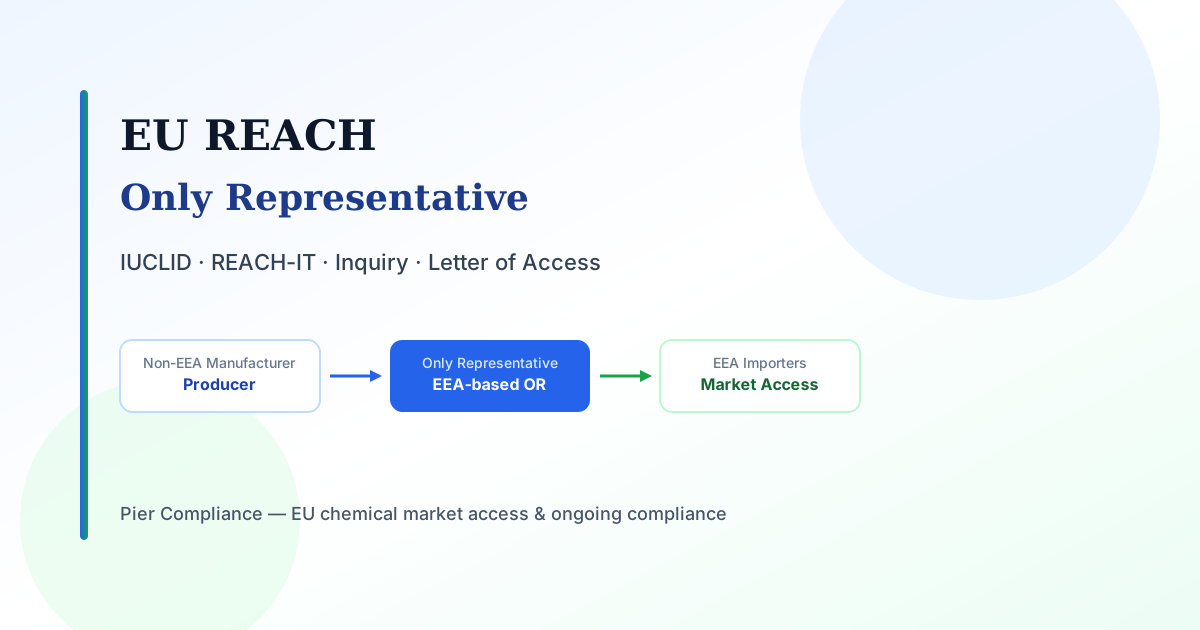
EU REACH Registration in 2026: Only Representative and ECHA Process for Non-EEA Manufacturers
How non-EEA manufacturers register substances under EU REACH in 2026: Only Representative requirements, importer vs OR models, IUCLID/REACH-IT, data sharing, Letter of Access, costs drivers and ongoing compliance — Pier Compliance, Istanbul.
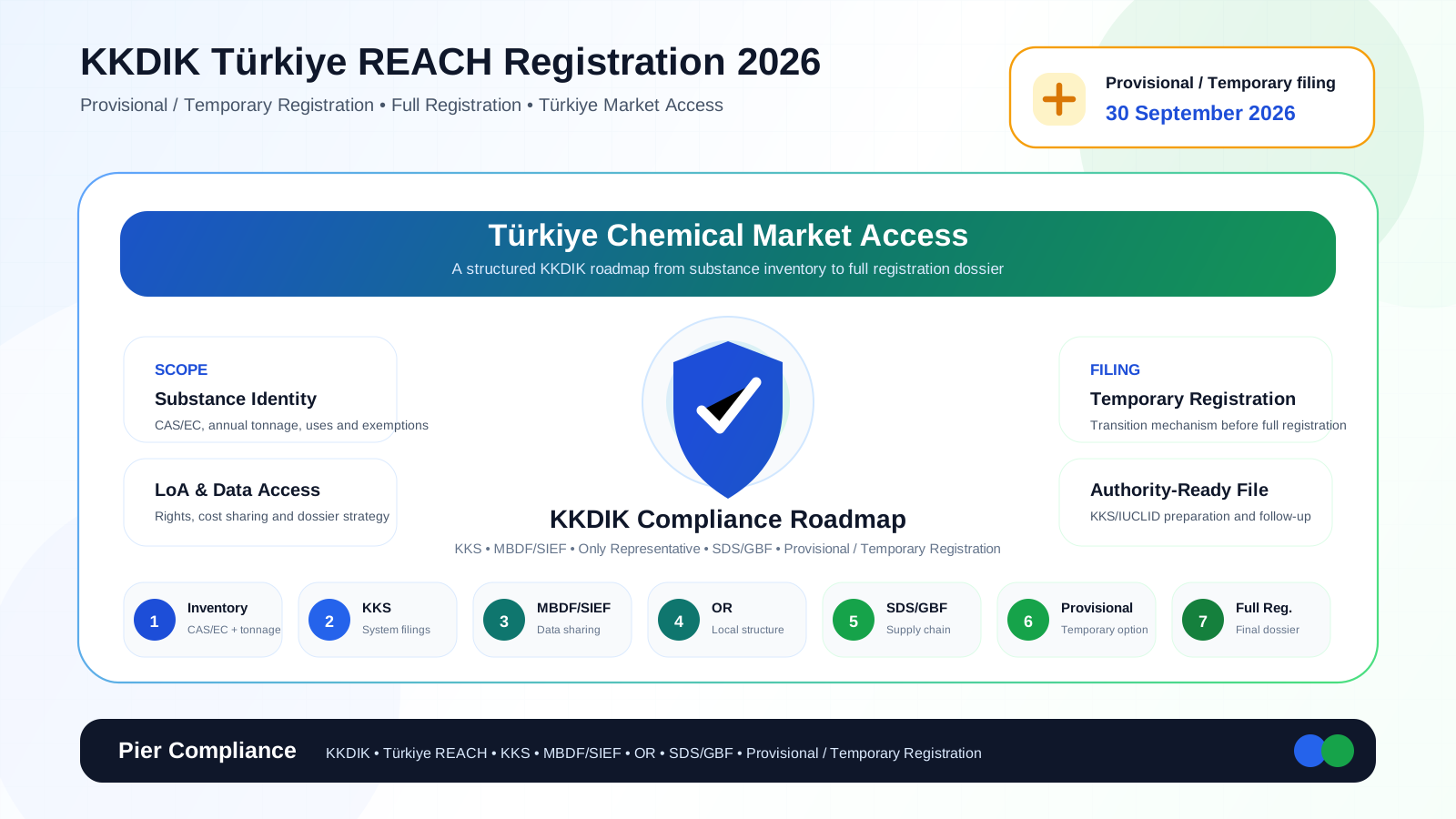
KKDIK Türkiye REACH Registration Guide 2026: Provisional / Temporary Registration, Full Registration and Market Access
A practical guide to KKDIK Türkiye REACH registration, the 30 September 2026 provisional / temporary registration deadline, Only Representative services, MBDF/SIEF, SDS, LoA and full registration strategy.
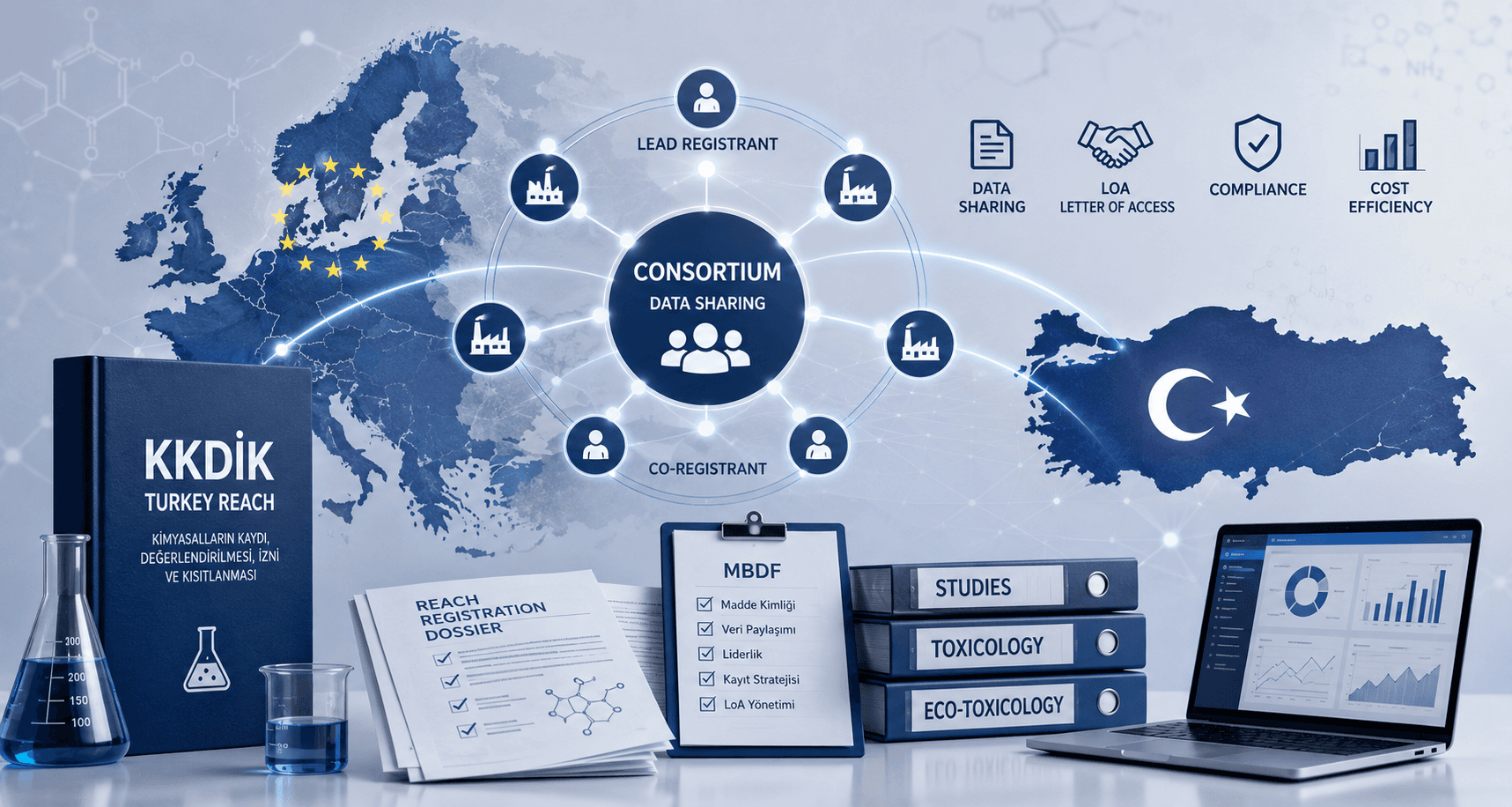
KKDIK and Consortiums: Why MBDF, LoA and REACH Data Sharing Matter in Türkiye
What is a KKDIK or REACH consortium, why is it needed, and how do MBDF, LoA, lead registrant and data sharing affect Turkey REACH registration? Practical guidance from Pier Compliance.