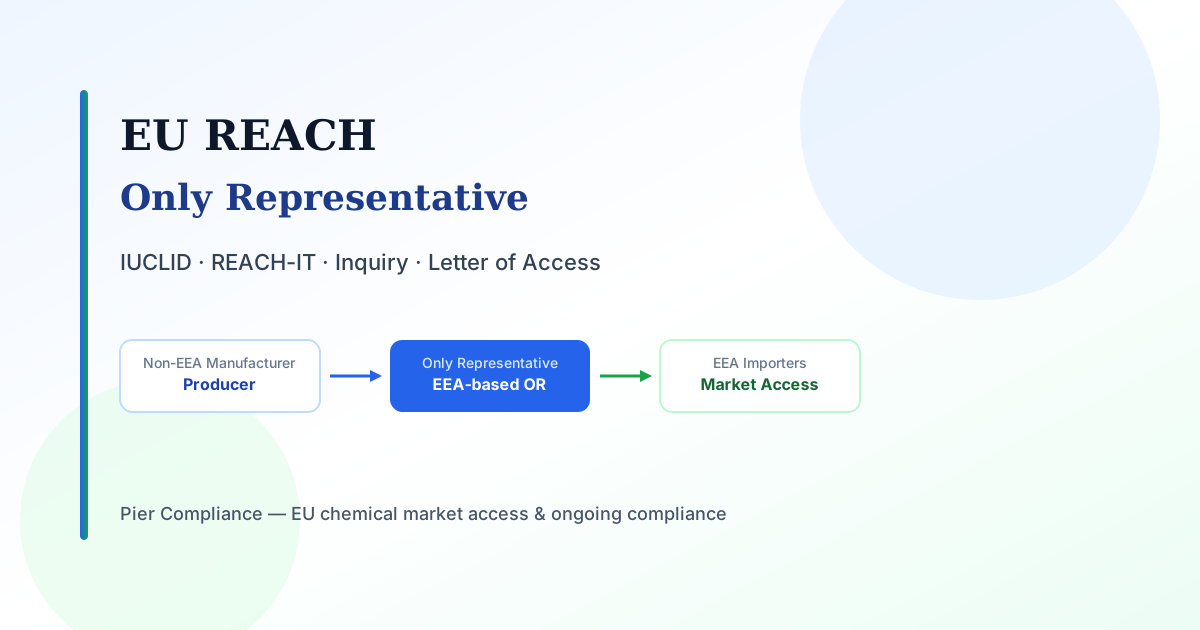
Short answer: Non-EEA manufacturers — including companies in Türkiye — cannot register substances directly with ECHA. EU REACH registration is performed by an EEA importer or by an Only Representative (OR) established in the EEA. Pier Compliance, based in Istanbul, designs and coordinates engineering-based REACH registration and OR programmes so exporters can place substances on the EU/EEA market with a defensible dossier, tonnage control and ongoing compliance system.
If you manufacture chemicals, intermediates, specialty additives or formulated products outside the EEA and sell into the European market, REACH is not a paperwork afterthought. It is a market-access condition. Without a coherent registration pathway, shipments stall, customers reject supply, and enforcement actions expose gaps that should have been closed at the inventory stage.
This guide explains how EU REACH compliance works in practice in 2026 for non-EEA manufacturers: roles, the OR model, the ECHA process, IUCLID versus REACH-IT, data sharing, cost and timeline drivers, and what continues after the registration number appears.
Table of contents
- What is EU REACH and why it matters
- Who may have registration obligations
- Can a Turkish manufacturer register with ECHA directly?
- What is a REACH Only Representative?
- How Pier Compliance approaches Only Representative and registration programmes
- Step-by-step REACH registration process
- Most common REACH mistakes
- Pre-assessment checklist
- Why Pier Compliance
- Conclusion
Key takeaways
- Non-EEA manufacturers cannot be REACH registrants; use an EEA importer or an EEA-established Only Representative.
- The OR model centralises registration, tonnage and covered-importer management for exporters with multiple EU customers.
- Substance identity (composition, purity, UVCB logic) decides whether you join existing data or face a new inquiry path.
- IUCLID builds the dossier; REACH-IT handles submission and ECHA communication — both matter.
- Cost and duration depend on tonnage band, data gaps, LoA terms and programme design — not on a single published price.
- Registration is the start of a lifecycle: SDS/eSDS, updates, SVHC/restriction/authorisation tracking and supply-chain communication continue.
What is EU REACH and why it matters
REACH — Registration, Evaluation, Authorisation and Restriction of Chemicals — is set out in Regulation (EC) No 1907/2006. It is the core EU framework for managing chemical substances placed on the EEA market.
| Pillar | What it means in practice |
|---|---|
| Registration | Manufacturers and importers of ≥1 t/year generally must submit a dossier to ECHA covering identity, hazard data, uses and, where required, chemical safety assessment. |
| Evaluation | ECHA and Member States may examine testing proposals, compliance of dossiers and substance concerns. |
| Authorisation | Substances of very high concern (SVHCs) listed for authorisation may only be used or placed on the market after a granted authorisation, unless exempted. |
| Restriction | Annex XVII and related measures can limit or ban manufacture, placing on the market or use of certain substances or articles. |
For exporters, the operational message is simple: no valid registration pathway means no reliable EEA market access for substances in scope. Customers increasingly treat REACH status as a supplier-qualification criterion alongside SDS quality and SVHC declarations.
Official starting points include ECHA’s pages on registration and creating a registration dossier.
Who may have registration obligations
Obligations follow role and tonnage, not brand size. The table below summarises typical positions.
| Role | Typical registration trigger | Notes for non-EEA supply chains |
|---|---|---|
| EEA manufacturer | Manufacture ≥1 t/year in the EEA | Not the usual case for Turkish exporters of finished chemicals. |
| EEA importer | Import ≥1 t/year into the EEA | Default registrant when no OR is appointed. |
| Only Representative (EEA-established) | Appointed by non-EEA manufacturer; covers specified imports | Enables centralised registration for covered importers. |
| Non-EEA manufacturer | Cannot register directly | Must work via importer(s) or OR. |
| Formulator / downstream user | Usually no registration for the mixture as such | May need to ensure substances in mixtures are registered for their uses; communicate uses up the chain. |
| Article producer / importer | Registration only in defined cases (e.g. intended release) | SVHC notification / SCIP duties may still apply. |
Volume is calculated per substance, per actor, per year, with specific rules for intermediates, polymers, recovered substances and exemptions. Role misclassification at the start of a project is one of the most expensive errors — it forces rework of contracts, tonnage ledgers and dossier ownership.
Can a Turkish manufacturer register with ECHA directly?
Answer first: No. A manufacturer established in Türkiye (or elsewhere outside the EEA) cannot submit an EU REACH registration in its own name as registrant.
Two lawful models remain:
| Model | Who is the registrant? | When it fits | Main trade-off |
|---|---|---|---|
| Importer-led | Each EEA importer (for its own tonnage) | Few importers; simple portfolio; importer willing to own the dossier | Fragmented tonnage; multiple registrations; weak central control for the manufacturer |
| Only Representative | One EEA-established OR appointed by the non-EEA manufacturer | Multiple EU customers/importers; manufacturer wants one programme | Requires a robust OR appointment, tonnage aggregation and importer coverage rules |
Many Turkish exporters prefer the OR model because it keeps strategy, substance identity and data-sharing negotiations under one programme rather than leaving each importer to invent a parallel path. That preference does not remove the legal requirement that the OR itself be established in the EEA (ECHA — Only Representative).
What is a REACH Only Representative?
Under REACH, a non-EEA manufacturer may appoint an Only Representative established in the EEA to fulfil the obligations of importers for the substances covered by the appointment. Covered importers then typically operate as downstream users for those imports, provided the OR arrangement and tonnage coverage are correctly implemented.
Practical OR responsibilities include:
- Confirming appointment scope (substances, tonnage bands, covered importers).
- Maintaining an accurate importer list and annual tonnage ledger for EEA supply.
- Running inquiry, data sharing and dossier submission via IUCLID/REACH-IT.
- Holding registration numbers and communicating status to the supply chain.
- Updating dossiers and supporting SDS/eSDS consistency when uses or classifications change.
- Retaining audit-ready contracts, change logs and decision records.
An OR is not a logo on a quotation. It is a regulated role with establishment, documentation and continuity duties. Firms that treat OR appointment as a checkbox usually discover gaps when a customer, customs authority or Member State inspector asks for the coverage map.
How Pier Compliance approaches Only Representative and registration programmes
Pier Compliance is an Istanbul-based regulatory compliance firm (Aydınlı Mah. Umutlu Sk., Natura Sitesi A1 Blok No: 1/A, İç Kapı No: 2, 34953 Tuzla/İstanbul, Istanbul, Turkey). We bridge Türkiye and EU chemical frameworks with an engineering-based approach: substance identity first, then tonnage and uses, then dossier architecture, then commercial LoA strategy.
Because REACH requires the Only Representative to be EEA-established, we coordinate and manage the REACH OR and registration programme for clients — programme design, technical dossier work, data-sharing strategy, IUCLID/REACH-IT workflows, SDS/eSDS alignment and ongoing compliance — without presenting Istanbul as an EEA legal establishment for the OR role itself.
Typical programme modules:
- Portfolio scoping and role confirmation (manufacturer / formulator / article logic).
- Substance identity packages and analytical evidence plans.
- Importer and tonnage mapping for EEA destinations.
- Inquiry and joint-registration / LoA strategy.
- Dossier build in IUCLID and submission support in REACH-IT.
- SDS / eSDS preparation aligned with registered uses.
- Change control: new importers, tonnage band shifts, new uses, classification updates.
- Parallel KKDIK planning where Türkiye market access is also required.
We do not claim “ECHA approval”, “guaranteed registration” or invented registration numbers. We deliver a defensible process and documentation system matched to your substances and supply chain.
Step-by-step REACH registration process
A workable programme usually follows these 14 steps. Sequence can flex, but skipping early identity and role work almost always creates later cost.
- Confirm economic roles — Who manufactures, who imports into the EEA, who formulates, who places articles on the market?
- Build the substance inventory — Names, CAS/EC, trade names, intermediates, impurities of concern.
- Map EEA tonnage — Historical and forecast volumes per substance and per importer/customer.
- Decide importer-led vs OR model — Document the decision and the coverage rules.
- Appoint the EEA-established OR (if chosen) — Contract, scope, confidentiality, change-notification duties.
- Lock substance identity — Composition, purity, UVCB characterisation, sameness criteria versus existing registrants.
- Collect use and exposure information — Industrial, professional and consumer uses; process categories; risk management measures.
- Run the inquiry (where required) — Identify previous registrants and available studies via ECHA.
- Negotiate data sharing / Letter of Access — Cost, rights, tonnage band, update mechanisms.
- Prepare the IUCLID dossier — Technical dossier; CSA/CSR where tonnage and hazard profile require it.
- Submit via REACH-IT — Company account hygiene, fee handling where applicable, completeness expectations.
- Communicate registration status — Registration numbers, covered importers, SDS updates to the chain.
- Align SDS/eSDS and labels — Classification, exposure scenarios and safe-use advice consistent with the dossier.
- Enter continuous compliance — Tonnage surveillance, dossier updates, SVHC/restriction/authorisation watch.
For exporters also serving Türkiye, keep a parallel track with our KKDIK Türkiye REACH registration guide 2026 — EU and Turkish filings are separate legal acts.
Why substance identity is foundational
Almost every expensive REACH delay traces back to identity. If your substance is not the “same” as the one already registered, you cannot simply buy into existing data on the assumption that the CAS number matches a catalogue entry.
Identity work typically covers:
- Structural identifiers and naming conventions.
- Purity profile and impurity/constituent quantification.
- UVCB or multi-constituent characterisation strategies.
- Analytical methods and batch variability.
- Alignment with the boundary of an existing joint registration.
Without a clear identity package, inquiry responses, LoA negotiations and dossier acceptance all become speculative. Pier Compliance treats identity as an engineering deliverable, not a spreadsheet column.
Inquiry, data sharing and Letter of Access
Before registering a substance that has already been registered (or for which studies exist), REACH requires potential registrants to inquire so that animal testing is not duplicated and existing data can be shared. Historically, co-registrants organised through SIEF structures; today the operational focus is on identifying previous registrants, data owners and fair cost sharing for the studies you need to refer to.
A Letter of Access (LoA) is the usual commercial instrument: it grants the right to refer to specified studies or a full data package for an agreed tonnage band and fee. Negotiation variables include:
- Which studies are included versus excluded.
- Tonnage band covered by the fee.
- Rights to updates and new studies.
- Consortium membership versus LoA-only access.
- Payment milestones and audit clauses.
Poor LoA timing is a classic project killer: dossiers sit unfinished while commercial talks drift. Build data-sharing into the critical path from day one.
IUCLID vs REACH-IT
| System | Role | Typical user tasks |
|---|---|---|
| IUCLID | Dossier authoring format/tool | Enter substance identity, endpoints, robust study summaries, CSR linkages; validate dossier structure. |
| REACH-IT | ECHA submission portal | Company and legal-entity accounts, inquiry, dossier upload, fee invoices, messaging with ECHA. |
Confusing the two creates false confidence (“we have IUCLID files, so we are registered”). Registration status lives in the submitted and accepted REACH-IT outcome, backed by a coherent IUCLID dossier. ECHA documents both the dossier creation and REACH-IT registration paths.
What drives REACH registration cost
There is no honest single price for “REACH registration”. Credible estimates start from substance facts. Major cost drivers include:
| Cost driver | Why it moves the budget |
|---|---|
| Tonnage band | Higher bands require more endpoints and often a CSR. |
| Data gaps | New studies (especially vertebrate) dominate cost and timeline. |
| Letter of Access / consortium fees | Often the largest cash item for well-studied substances. |
| Substance identity complexity | UVCB or contested sameness increases consulting and analytical spend. |
| Number of uses / exposure scenarios | Expands CSR and eSDS work. |
| OR and programme management | Ongoing tonnage control, importer updates, dossier maintenance. |
| ECHA fees | Depend on tonnage, company size category and submission type where applicable. |
| Parallel regimes | KKDIK or UK REACH add separate filings even when data is reusable. |
Pier Compliance issues substance-specific estimates after a structured pre-assessment. We separate official fees, data access fees and service fees so finance teams can budget without mixing categories.
How long does registration take
Duration depends on readiness, not slogans. Factors that stretch calendars:
- Incomplete composition or missing analytical evidence.
- Slow responses from data owners during LoA talks.
- Need for new testing or testing proposals.
- CSR complexity for higher tonnage or hazardous profiles.
- Internal delays on importer lists and tonnage confirmations.
- Parallel customer audits demanding status letters before submission is finished.
Straightforward cases with clear identity and an available LoA can move relatively quickly once contracts and dossiers are ready. Novel substances or contested identities take longer. No single promised date is credible without those inputs — and none should be sold as a guarantee.
Does obligation end after registration?
No. A registration number is a milestone, not a finish line.
Ongoing duties typically include:
- Keeping tonnage and use information accurate as sales grow or new importers are added.
- Updating the dossier when new hazard information or classification changes appear.
- Maintaining SDS/eSDS aligned with registered uses and exposure scenarios.
- Watching the Candidate List, authorisation list and Annex XVII restrictions.
- Supporting customer questionnaires, audit packs and customs documentation.
- Coordinating with formulators so mixture SDS remain consistent with upstream registration boundaries.
Companies that “close the project” after first submission often reopen it under pressure — at higher cost and with weaker evidence trails.
Related obligations: CLP, SDS/eSDS, SVHC, SCIP, authorisation, Annex XVII
REACH registration sits inside a wider compliance stack:
| Topic | Interface with registration |
|---|---|
| CLP | Classification and labelling must be coherent with dossier hazard conclusions. |
| SDS / eSDS | Communication tool for safe use; exposure scenarios for registered hazardous substances above relevant thresholds. |
| SVHC / Candidate List | May trigger supply-chain communication and article duties even when registration is complete. |
| SCIP | Article suppliers may need database notifications for Candidate List substances above 0.1% w/w. |
| Authorisation | Annex XIV substances may need authorised uses regardless of registration history. |
| Annex XVII restrictions | Can limit concentration, use or placing on the market independently of tonnage registration. |
Treat these as a connected system. A perfect registration number does not rescue a non-compliant label or an obsolete SDS.
EU REACH vs KKDIK vs UK REACH
| Aspect | EU REACH | KKDIK (Türkiye) | UK REACH |
|---|---|---|---|
| Legal base | Regulation (EC) No 1907/2006 | Turkish KKDIK regulation | UK REACH regime (GB) |
| Authority / systems | ECHA; IUCLID; REACH-IT | Ministry / KKS ecosystem | UK agency systems |
| Non-domestic manufacturer path | EEA-established OR or EEA importers | Türkiye-based OR or Turkish importers | UK-based OR or GB importers |
| Data reuse | Often technically reusable | Often reusable with remapping | Often reusable with remapping |
| Automatic mutual recognition? | No | No | No |
Exporters serving multiple regions need a portfolio plan, not three disconnected panic projects. See also our KKDIK guide and Only Representative under KKDIK.
Most common REACH mistakes
- Assuming a Turkish (or other non-EEA) company can register directly in REACH-IT.
- Appointing an “OR” that is not EEA-established.
- Treating CAS numbers as proof of substance sameness without composition evidence.
- Letting each importer invent a separate registration story without tonnage aggregation.
- Starting LoA talks after the customer deadline has already passed.
- Confusing IUCLID file existence with completed REACH-IT registration.
- Ignoring intermediates, impurities or polymer monomer logic until audit time.
- Freezing SDS work until “after registration”, then failing customer onboarding.
- Closing the project after the registration number — no update or tonnage control.
- Mixing EU REACH, KKDIK and UK REACH deadlines into one false “already done” status.
Pre-assessment checklist
Use this list before budgeting or promising customers a registration date:
- Substance list with CAS/EC, trade names and intended EEA uses
- Composition / purity / UVCB characterisation status
- Annual and forecast EEA tonnage by substance
- Importer / distributor / customer map for EEA destinations
- Decision memo: importer-led vs EEA-established OR
- Existing SDS, labels and classification rationale
- Known prior inquiry, registration or LoA history
- Analytical reports and method summaries
- Internal owner for tonnage and change notifications
- Parallel KKDIK / UK needs flagged
Bring this pack to a scoping call and the programme can move from opinion to a sequenced plan.
Why Pier Compliance
Pier Compliance combines Istanbul proximity to Turkish manufacturers with structured EU REACH programme management:
- Engineering-led substance identity and dossier logic.
- Only Representative coordination consistent with the EEA-establishment rule.
- IUCLID / REACH-IT workflow support and data-sharing strategy.
- SDS/eSDS and classification alignment as part of the same system.
- Ongoing compliance partnering — not a one-off file drop.
- Clear separation of official fees, LoA costs and service fees.
Contact: info@piercompliance.com · +90 532 509 77 58 · Istanbul, Turkey (Aydınlı Mah. Umutlu Sk., Natura Sitesi A1 Blok No: 1/A, İç Kapı No: 2, 34953 Tuzla/İstanbul).
Conclusion
EU REACH registration in 2026 remains a role-based, identity-driven, lifecycle process. Non-EEA manufacturers need either cooperative EEA importers or an EEA-established Only Representative, supported by inquiry, data sharing, IUCLID dossiers and REACH-IT submission — then continuous SDS and dossier maintenance.
Ready to structure your EU REACH registration or Only Representative programme? Review EU REACH compliance, align SDS preparation, coordinate KKDIK where needed, and contact Pier Compliance.
Frequently asked questions
- Can a Turkish manufacturer register a substance directly with ECHA?
- No. Non-EEA manufacturers cannot act as registrants under EU REACH. Registration is carried out by an EEA importer or by an Only Representative established in the EEA and appointed by the non-EEA manufacturer.
- What is a REACH Only Representative (OR)?
- An Only Representative is a natural or legal person established in the EEA who is appointed by a non-EEA manufacturer to fulfil the registration and related importer obligations for substances exported into the EEA. See ECHA’s Only Representative guidance.
- Must the Only Representative be established in the EEA?
- Yes. Under REACH, the OR must be established in the European Economic Area. This is a legal establishment requirement, not a branding preference. Pier Compliance, based in Istanbul, coordinates and manages OR and registration programmes for clients through the appropriate EEA-established OR structure.
- What is the difference between an importer registration and an OR registration?
- In the importer model, each EEA importer registers (or relies on its own registration) for the tonnage it places on the market. In the OR model, the non-EEA manufacturer appoints one EEA-established OR that covers covered importers, so registration and tonnage control can be managed centrally.
- When is REACH registration required?
- As a rule, substances manufactured in or imported into the EEA in quantities of 1 tonne or more per year per manufacturer/importer must be registered, subject to exemptions and special regimes set out in Regulation (EC) No 1907/2006.
- What is the inquiry process before registration?
- Before submitting a full registration for the same substance, potential registrants must inquire with ECHA so that existing studies and previous registrants can be identified and data sharing can proceed. Inquiry is a legal step, not an optional courtesy.
- What is a Letter of Access (LoA)?
- A Letter of Access is the contractual instrument that grants a registrant the right to refer to jointly owned or third-party study data in a registration dossier, usually against a cost-sharing fee negotiated with the data owner or consortium.
- What is the difference between IUCLID and REACH-IT?
- IUCLID is the dossier preparation software/format for substance data. REACH-IT is ECHA’s online system for company accounts, inquiry, submission, invoicing and communication. Both are required in a typical registration workflow.
- How much does REACH registration cost?
- There is no single price. Cost drivers include tonnage band, data gaps, Letter of Access fees, consortium terms, CSR/CSA needs, number of uses, OR and programme management fees, and ECHA fees where applicable. Pier Compliance provides substance-specific estimates after a pre-assessment — we do not publish invented price lists.
- How long does REACH registration take?
- Timelines vary with substance identity complexity, data availability, LoA negotiation, dossier completeness and ECHA processing. Some straightforward LoA-based registrations move faster; novel identities or data-gap cases take longer. No credible firm promises a fixed calendar date without facts.
- Does REACH obligation end after the registration number is issued?
- No. Registrants must keep tonnage and use information up to date, update dossiers when new data or classification changes arise, maintain compliant SDS/eSDS, and manage authorisation, restriction and SVHC-related duties where they apply.
- How does Pier Compliance support EU REACH registration?
- Pier Compliance is an Istanbul-based regulatory compliance firm. We bridge Türkiye and EU chemical frameworks with engineering-based EU REACH registration programme design, Only Representative coordination, IUCLID/REACH-IT support, data-sharing strategy, SDS/eSDS alignment and ongoing compliance. Contact us at info@piercompliance.com or +90 532 509 77 58, or via /en/contact.
- How does EU REACH relate to KKDIK and UK REACH?
- They are separate legal regimes. EU REACH covers the EEA; KKDIK is Türkiye’s counterpart; UK REACH applies in Great Britain. Registration in one system does not automatically satisfy the others, though technical data can often be reused with care.
- What documents should we prepare before starting REACH registration?
- A substance inventory with CAS/EC identifiers, purity and composition (including UVCB logic where relevant), annual EEA tonnage by substance, importer/customer map, use and exposure information, existing SDS, analytical reports and any prior inquiry or registration history.
Related Posts
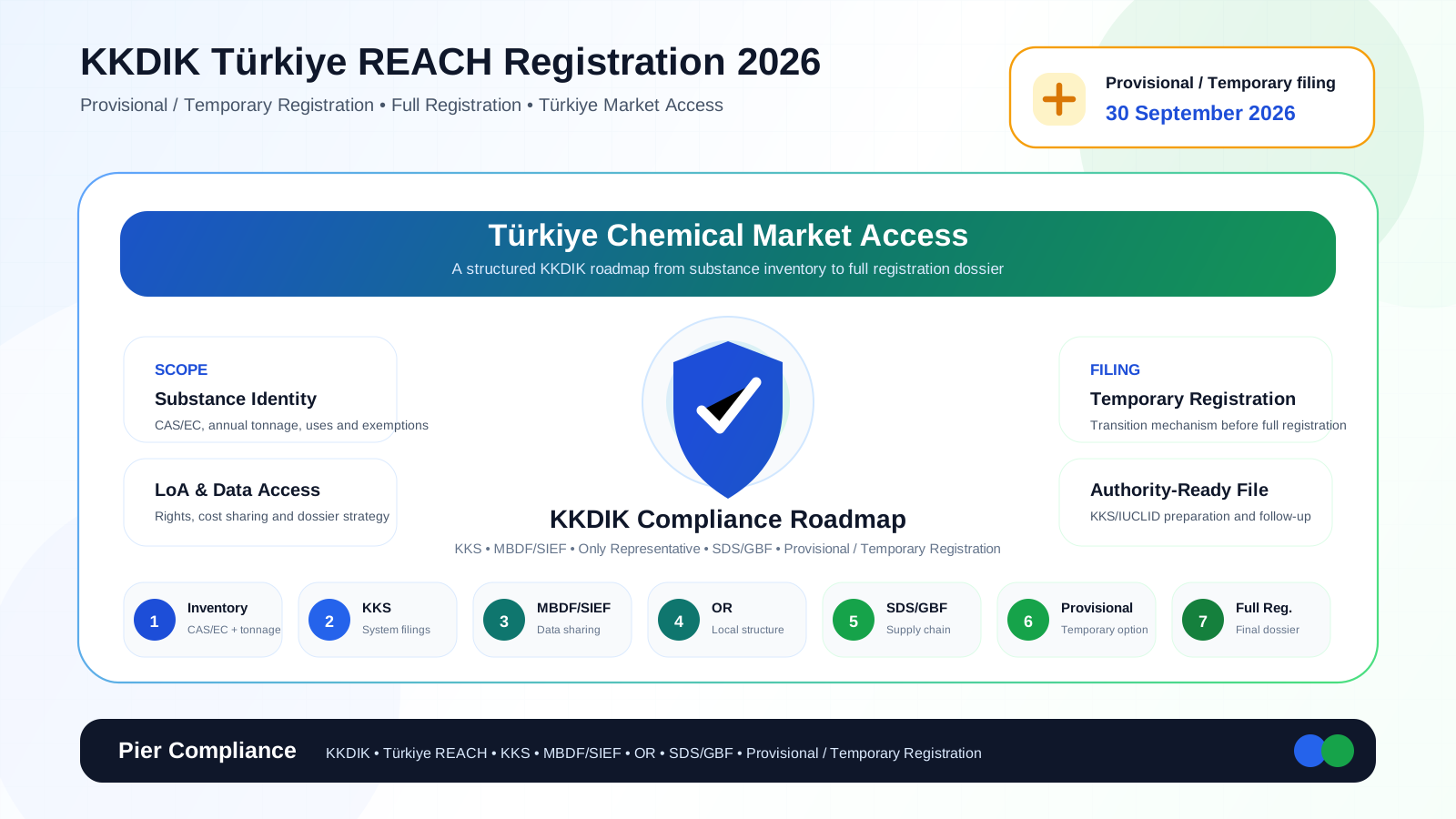
KKDIK Türkiye REACH Registration Guide 2026: Provisional / Temporary Registration, Full Registration and Market Access
A practical guide to KKDIK Türkiye REACH registration, the 30 September 2026 provisional / temporary registration deadline, Only Representative services, MBDF/SIEF, SDS, LoA and full registration strategy.
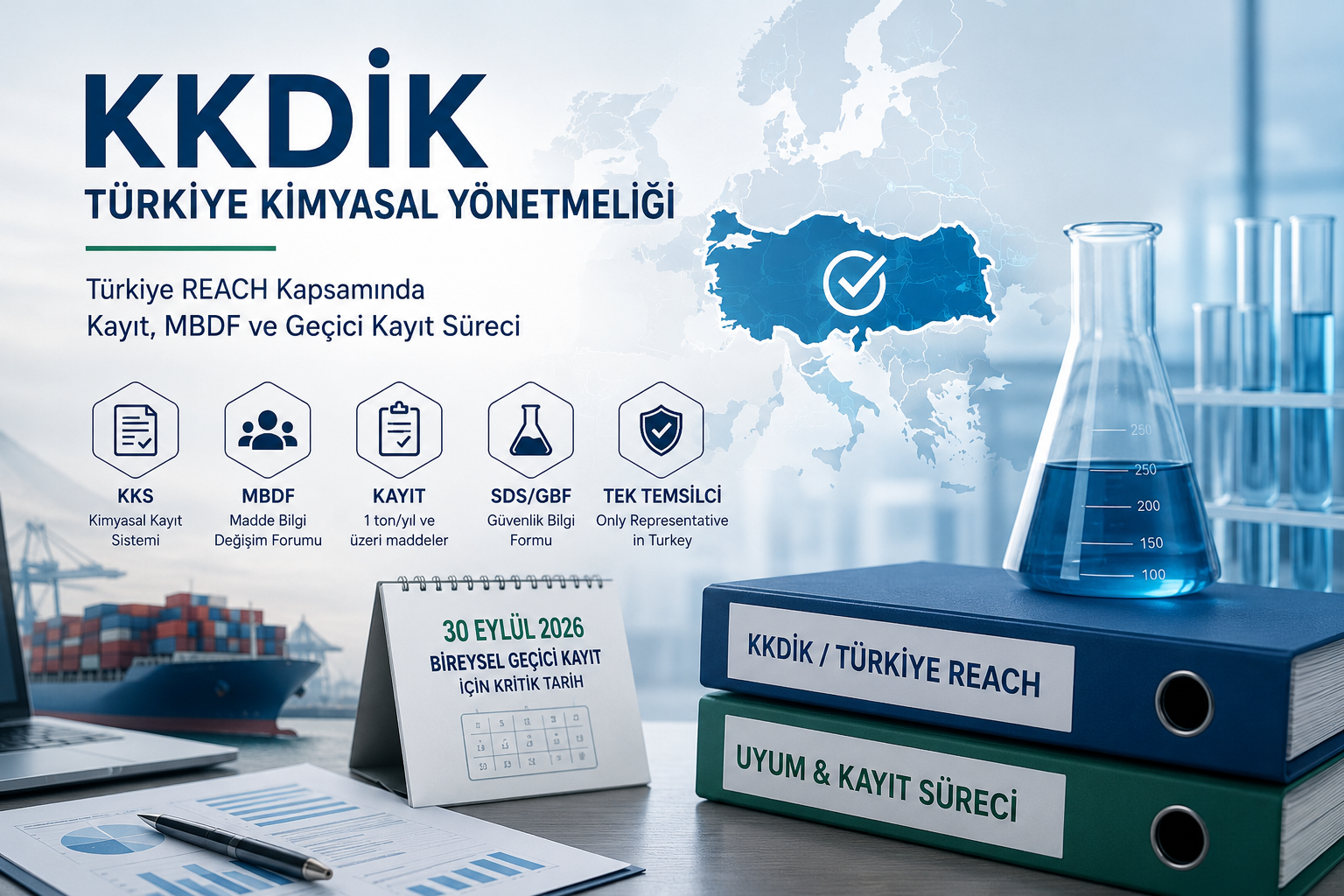
What Is KKDIK? Turkish REACH Registration, KKS, MBDF and Interim Registration Guide
Learn what KKDIK / Turkish REACH means, who must register, how KKS, Pre-MBDF/MBDF, Only Representative, SDS and 30 September 2026 interim registration planning work in Turkey.
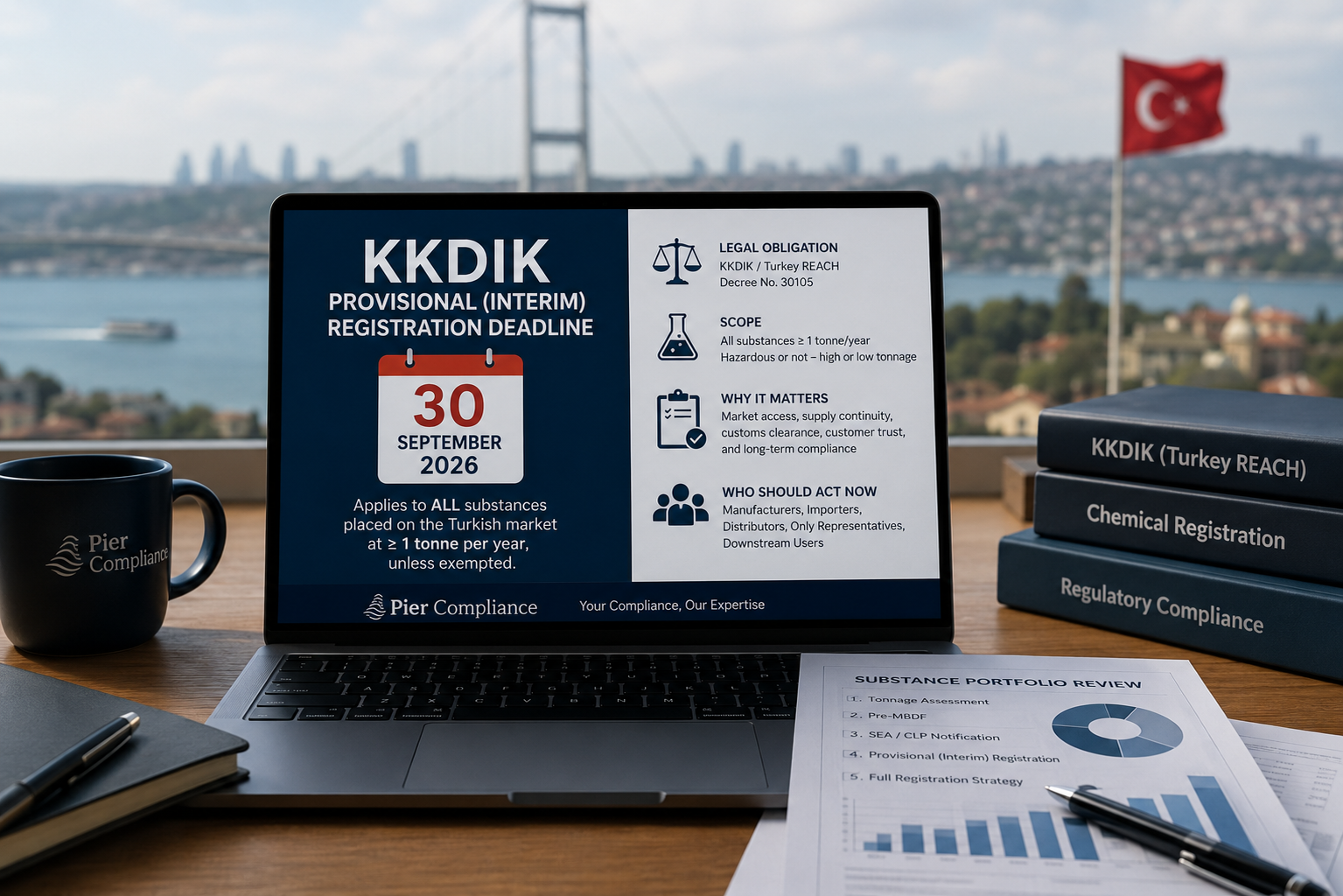
KKDIK Provisional (Interim) Registration Deadline: Why 30 September 2026 Matters for Companies Supplying Chemicals to Türkiye
30 September 2026 KKDIK provisional (interim) registration deadline for substances on the Turkish market at ≥1 tonne/year (unless exempt). Editorial Pier Compliance blog visual aligns with KKS, Pre-MBDF, OR and full-registration planning.