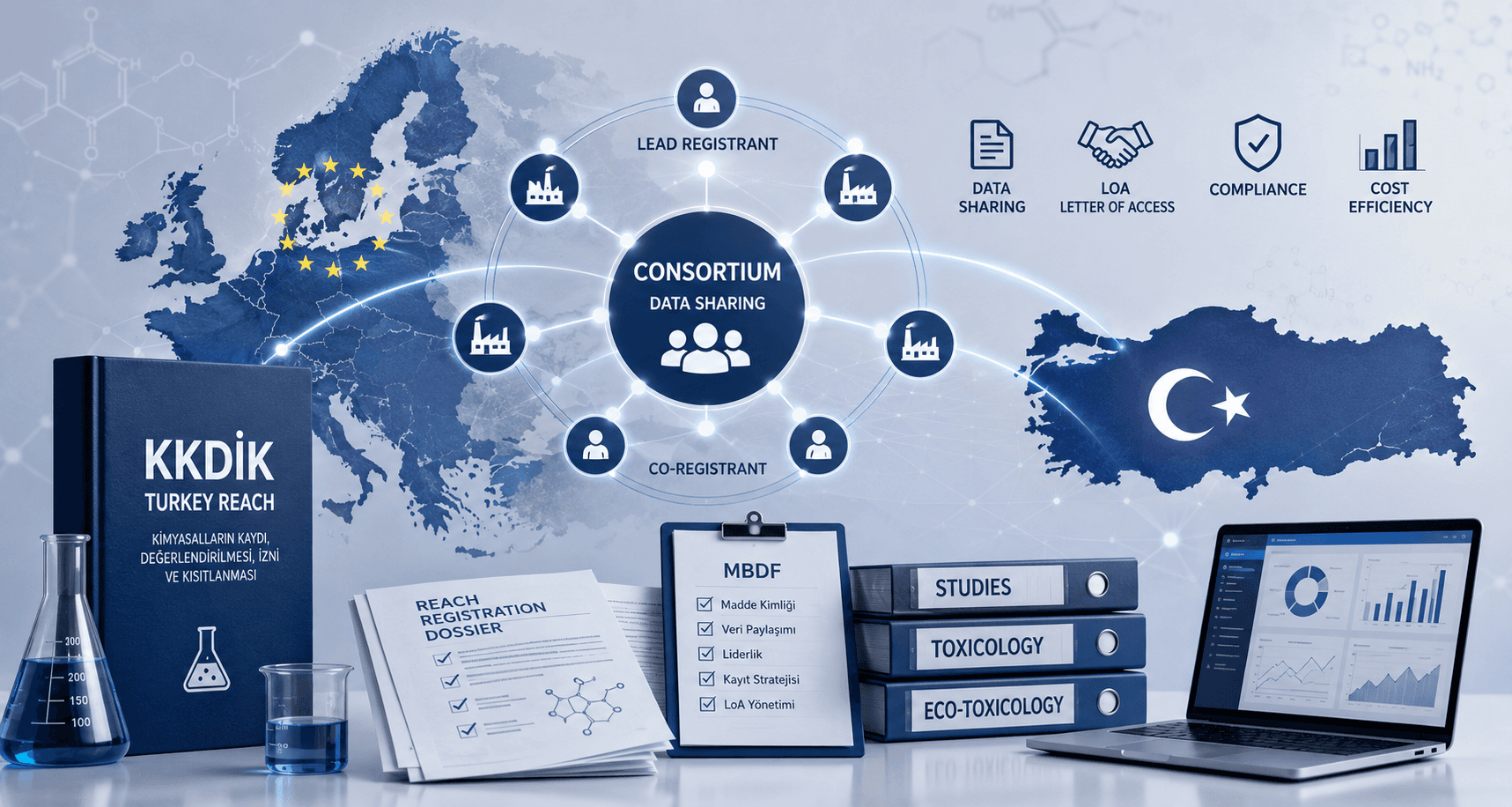
The role of consortiums in KKDIK registration
KKDIK is Türkiye’s framework for the registration, evaluation, authorisation and restriction of chemicals. For many substances placed on the Turkish market at one tonne or more per year, registration is not optional unless a specific exemption applies.
As the calendar moves toward 30 September 2026 — a key milestone for interim (provisional) registration — companies are also planning what happens next: full registration, MBDF positioning, LoA coverage and whether REACH-type consortium logic is in place for their substances.
Substances without a credible interim (provisional) or full registration number after relevant deadlines can face commercial continuity risk: customs questions, importer reluctance, customer audits and supply-chain disruption. Consortium and data-sharing discipline is therefore not only a cost topic — it is a market-access topic.
What is a consortium?
A consortium brings together companies that share registration obligations for the same substance or substance group to coordinate:
- technical dossier development
- study and data costs
- LoA / Letter of Access negotiation
- lead registrant support
- updates when regulation or data requirements change
Consortiums are well established under EU REACH. Under KKDIK, similar coordination is increasingly necessary because the same substance may be imported by several Turkish entities, supplied by non-Turkish manufacturers, or registered through different commercial routes.
A consortium is not a public authority. It is typically organised by companies, sector associations or data owners under private contractual rules.
Why are consortiums needed?
Sharing data costs
Toxicology and environmental studies are expensive. Sharing costs across registrants is often the only commercially realistic way to complete a robust dossier.
Avoiding duplicate testing
Without coordination, companies may commission redundant tests for the same substance — wasting budget and increasing animal testing where alternatives exist.
Reducing animal testing
Shared data strategies, where legally and technically justified, support 3Rs principles and align with how REACH SIEF/consortium practice evolved.
Managing a joint registration dossier
Someone must maintain version control, IUCLID/KKS logic, updates and consistency between members.
Supporting the lead registrant
The lead registrant carries significant technical and coordination load. A consortium can fund and govern that role transparently.
Organising LoA / Letter of Access processes
LoA terms (scope, updates, cost allocation, dispute resolution) are easier to manage in a structured consortium than ad hoc between strangers in MBDF.
Tracking dossier updates and regulatory change
When classification, uses or legal requirements shift, members need a channel to receive updates and implement them.
Fair, transparent and non-discriminatory cost sharing
Well-run consortiums document cost rules upfront — reducing later conflict between lead registrant and co-registrants.
What is MBDF and how is it different from a consortium?
MBDF (in KKDIK practice, analogous to SIEF thinking under EU REACH) is the communication and data-sharing space for potential registrants of the same substance. It helps parties:
- identify each other
- discuss data availability
- agree on data-sharing principles
- progress toward joint or aligned registration
MBDF is not a consortium. MBDF is primarily a regulatory communication forum. A consortium is a more formal contractual and operational structure: budgets, LoA templates, lead election, governance and long-term dossier maintenance.
Companies should run Pre-MBDF / MBDF early — not after interim (provisional) deadlines — and align MBDF outcomes with consortium contracts where needed. See our article on Pre-MBDF vs provisional registration.
Lead registrant and co-registrant roles
The lead registrant typically:
- prepares and maintains the core technical dossier
- interacts with MBDF participants on data gaps
- manages update cycles and technical consistency
Co-registrants (member registrants) join with:
- their tonnage band for Türkiye
- use and exposure information
- importer/downstream user mapping where relevant
Even with a lead, each company remains responsible for its KKDIK compliance. Assuming “the lead will handle everything” is one of the most common planning failures.
What is a Letter of Access?
A Letter of Access (LoA) grants the right to cite or use existing studies or the joint dossier in your registration. It is usually:
- a use/reference right, not necessarily ownership transfer
- limited by scope (substance identity, endpoints, territories, registration type)
- linked to cost and update obligations
For KKDIK, you must verify that LoA language covers Turkish registration — not only EU REACH.
Can EU REACH data be used for KKDIK?
Sometimes yes — but only with proper rights. Studies used in an EU REACH dossier may be reusable in KKDIK if the data owner or consortium grants permission through:
- LoA
- licence to use
- another data-use agreement
The risky assumption is: “We are REACH-registered, so KKDIK data is solved.” That is rarely true without written confirmation for the Turkish context.
Substance identity must go beyond a CAS number alone — impurities, forms and supply chains matter.
Common mistakes companies make
- Treating an EU REACH LoA as automatically valid for KKDIK
- Relying on CAS alone for substance identity
- Starting MBDF communication too late
- Expecting the lead registrant to manage all legal and commercial issues alone
- Clarifying the Turkish importer chain too late
- Running SEA/CLP, Pre-MBDF and registration strategy in silos
- Failing to obtain written data ownership / use documents
- Planning interim (provisional) registration separately from full registration and LoA strategy
The role of consortiums in interim (provisional) registration
Interim (provisional) registration does not remove full registration duties. It buys time and continuity while you:
- stabilise MBDF membership
- secure LoA positions
- confirm whether a lead registrant is viable
- align with interim registration deadlines including 30 September 2026
After that milestone, substances without a defensible interim (provisional) or full registration position may face supply-chain pressure. Consortium planning should therefore start before the last administrative weeks.
How Pier Compliance can support your KKDIK strategy
Pier Compliance provides end-to-end support on:
- KKDIK obligation and applicability analysis
- substance identity and tonnage assessment
- Turkish importer-chain analysis
- Pre-MBDF and MBDF process management
- SEA/CLP notification (guide)
- lead registrant / co-registrant strategy
- LoA and data-access review
- EU REACH data usability for KKDIK
- interim (provisional) registration dossier preparation
- full registration strategy
- Only Representative services
- SDS preparation aligned with registration outputs
We also support adjacent programmes where relevant — for example EU REACH compliance and biocidal product authorisation — when portfolio scope requires it.
Conclusion
KKDIK consortiums are not only about splitting invoices. They protect technical quality, legal certainty, data access and continuity on the Turkish market. Firms that delay MBDF, LoA or lead registrant decisions often discover gaps only when customers or customs ask for proof.
Pier Compliance supports companies with KKDIK, MBDF, LoA, interim (provisional) registration, full registration and Only Representative services. Contact Pier Compliance at info@piercompliance.com to assess your obligations in Türkiye and build a reliable registration strategy. Explore our KKDIK service page for scope details.
Frequently asked questions
- What is a consortium under KKDIK?
- A consortium is a coordinated arrangement among companies with registration obligations for the same substance or substance group to share data, costs, technical dossier work and registration strategy. It is usually a private, contractual structure — not a government body — and plays a similar strategic role to REACH consortium practice.
- Is MBDF the same as a consortium?
- No. MBDF is the KKDIK communication and data-sharing forum for potential registrants of the same substance, comparable in purpose to a SIEF under EU REACH. A consortium is a more organised contractual framework for cost sharing, LoA management, lead registrant support and joint dossier governance.
- What is a Letter of Access?
- A Letter of Access (LoA) is the contractual right to refer to existing studies or to a joint registration dossier. It is typically a use or reference right, not automatic transfer of data ownership. For KKDIK, the right to rely on EU REACH data must be confirmed in writing for the Turkish registration context.
- Is an EU REACH LoA automatically valid for KKDIK?
- No. An EU REACH LoA does not automatically authorise use of the same data in a KKDIK dossier. You need a documented data-use position — LoA, licence to use, or another agreement — that explicitly covers KKDIK/Türkiye registration.
- What is the role of the lead registrant?
- The lead registrant manages the core technical part of the joint dossier, coordinates MBDF/consortium processes, and drives data access and update logic. Lead strategy becomes especially critical at full registration stage.
- What are the responsibilities of co-registrants?
- Co-registrants join the joint registration with their company-specific tonnage, uses and supply-chain information, participate in data and cost sharing, and remain responsible for their own KKDIK obligations even when a lead registrant is active.
- Does interim (provisional) registration remove full registration obligations?
- No. Interim (provisional) registration supports continuity while dossiers mature; it does not replace full KKDIK registration where required. After interim milestones such as 30 September 2026, MBDF, LoA, lead registrant and full registration planning must still be in place.
- How can Pier Compliance support KKDIK consortium and MBDF processes?
- Pier Compliance supports obligation analysis, substance identity and tonnage review, Turkish importer-chain mapping, Pre-MBDF/MBDF management, SEA/CLP alignment, lead and co-registrant strategy, LoA and EU REACH data usability review, interim (provisional) and full registration planning, Only Representative services, and SDS preparation. Contact info@piercompliance.com.
Related Posts
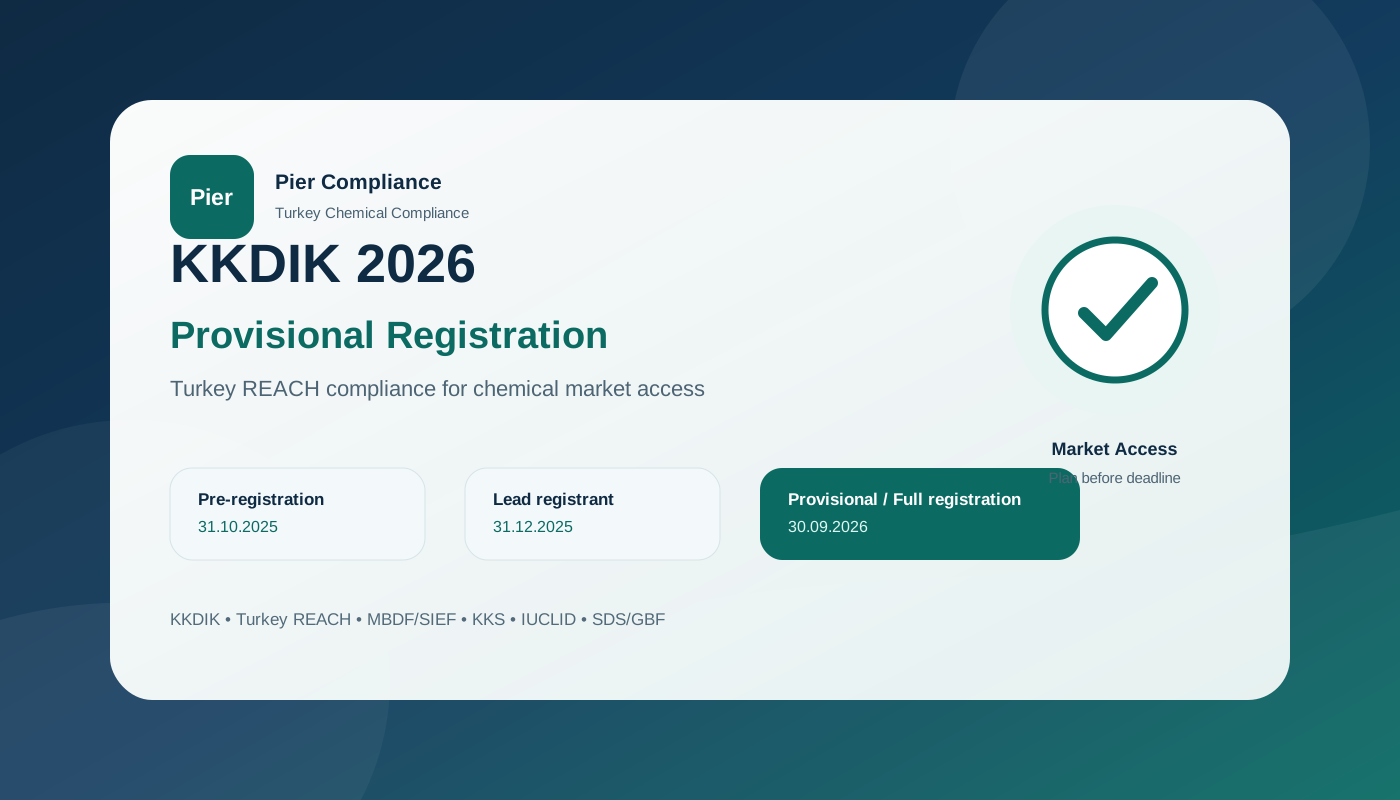
KKDIK Registration and Consulting Services 2026: Provisional Registration, Individual Filing and Turkey REACH Compliance
Pier Compliance supports companies with KKDIK 2026 pre-registration, MBDF/SIEF, lead and co-registration, individual provisional registration, full registration, KKS and IUCLID dossiers.
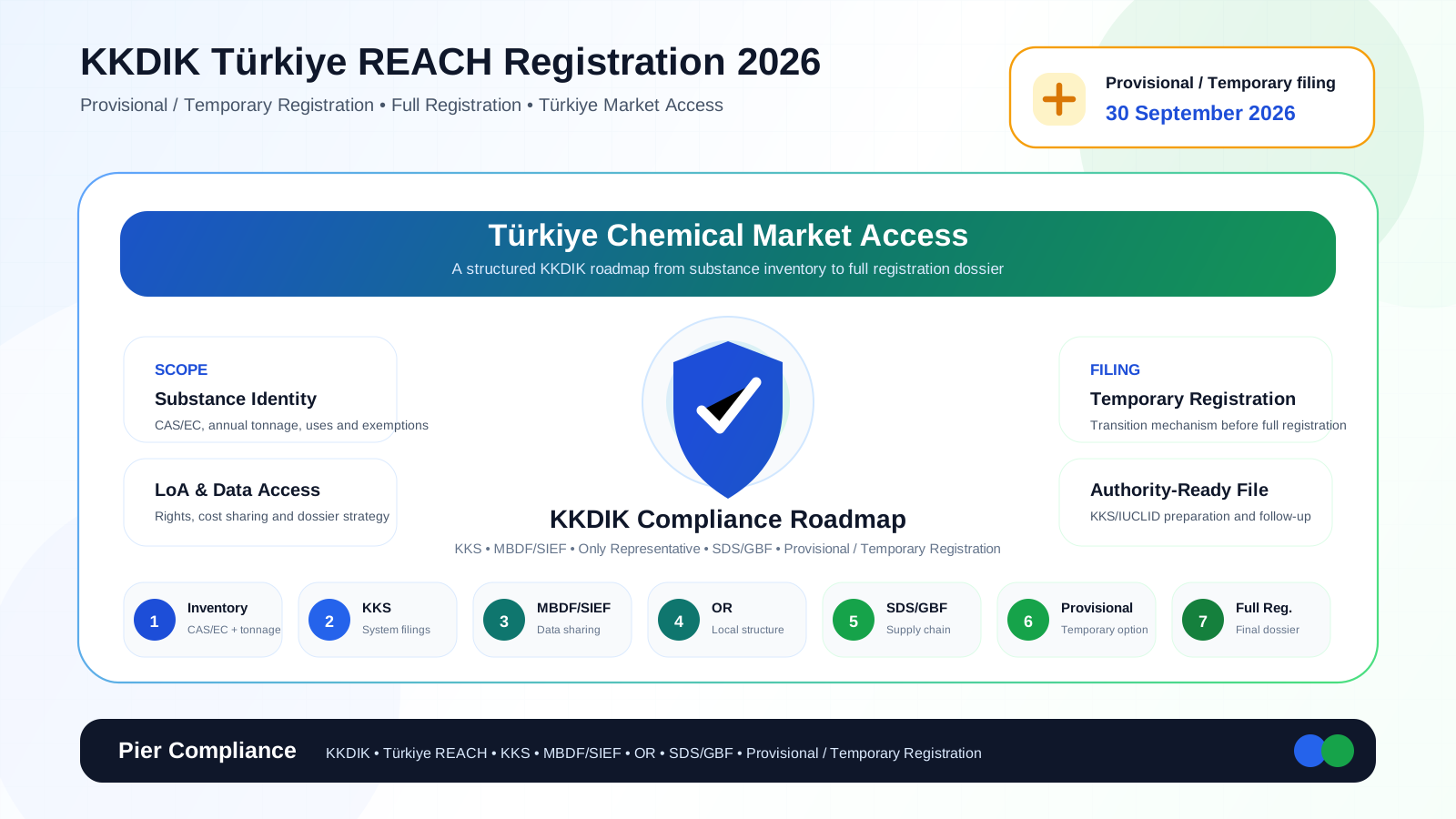
KKDIK Türkiye REACH Registration Guide 2026: Provisional / Temporary Registration, Full Registration and Market Access
A practical guide to KKDIK Türkiye REACH registration, the 30 September 2026 provisional / temporary registration deadline, Only Representative services, MBDF/SIEF, SDS, LoA and full registration strategy.
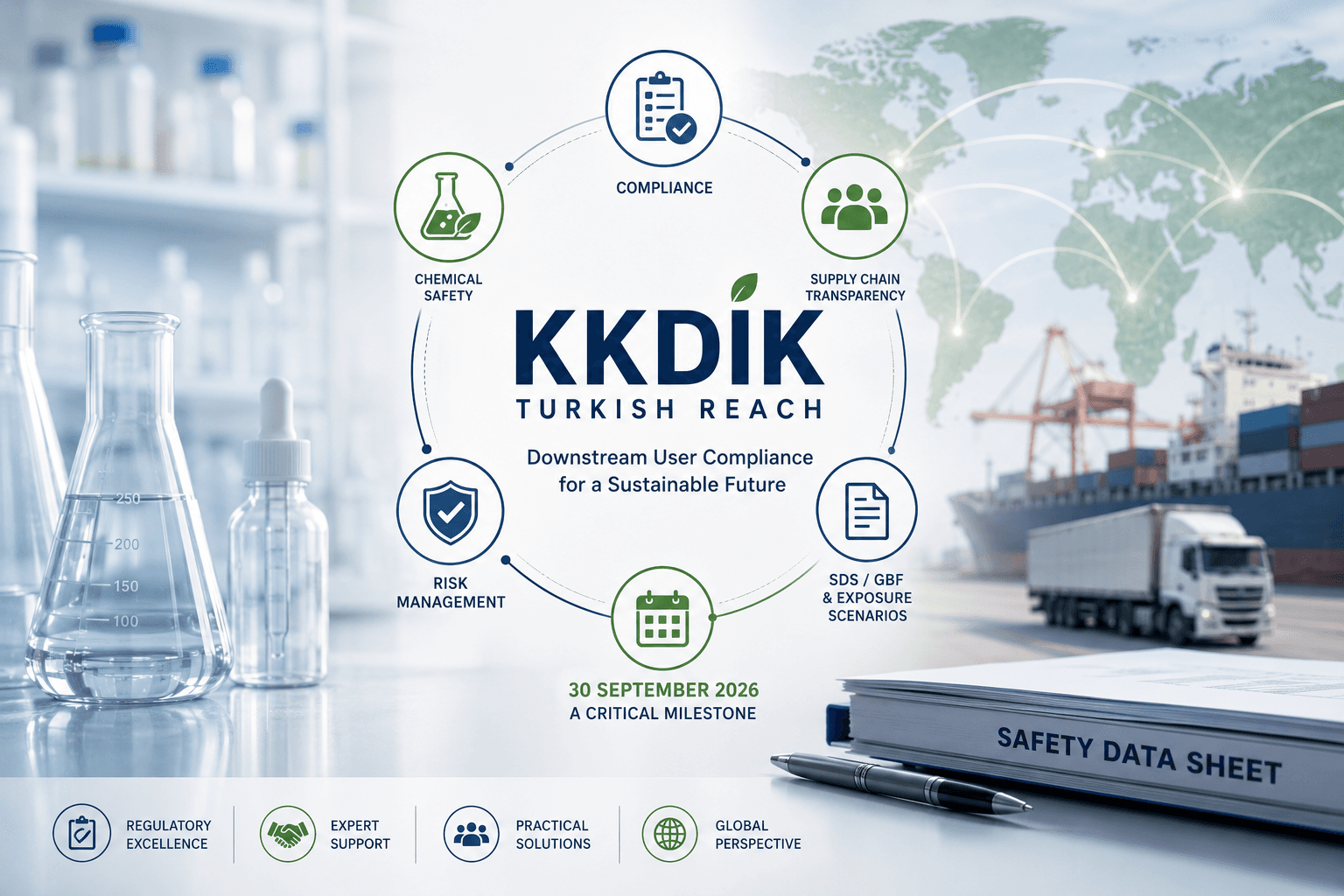
KKDIK Downstream Users: What You Need to Know Before 30 September 2026
Before the 30 September 2026 KKDIK interim registration milestone, downstream users should review use notification, SDS alignment, exposure scenarios and supply-chain roles. Pier Compliance supports role mapping and Chemical Assessment Specialist–approved SDS.