KKDIK Individual Interim (Provisional) Registration Guide: Who Needs It and Which Path to Follow?
Under Turkey REACH, individual interim (provisional) registration is often misunderstood. Some teams see it as mandatory only when there is no lead; others think it becomes irrelevant once a lead is appointed. In practice, the decision is scenario-based.
A robust strategy combines your legal role (Turkish legal entity vs. Only Representative), tonnage reality, current KKS status, SEA consistency, and pre-MBDF maturity. This guide is designed to support that decision with operational clarity.
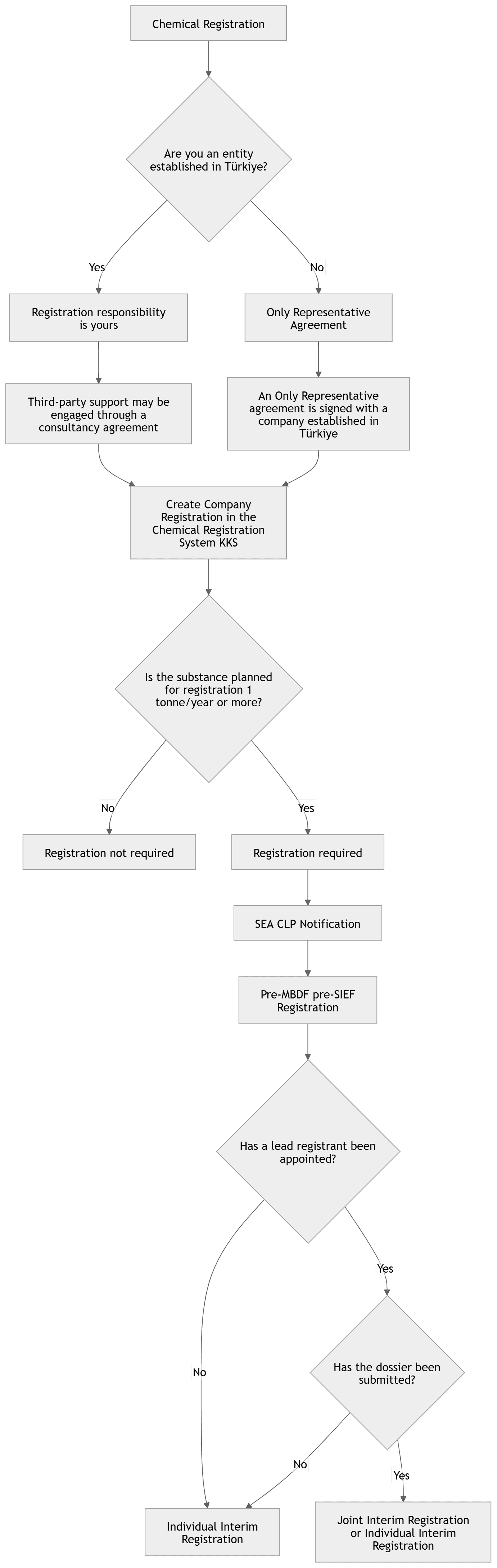
KKDIK individual interim (provisional) registration decision flow (Flowchart)
1) What is KKDIK individual interim (provisional) registration?
It is a registration pathway in KKS (Kimyasal Kayit Sistemi) that allows a company to maintain progress independently from lead-file timing. Its value is risk control: you reduce the chance of waiting-driven delays.
2) Which companies should pay special attention?
- Importers placing substances on the Turkish market
- Turkish manufacturers crossing or approaching critical tonnage
- Portfolio owners managing the same substance across multiple suppliers
- Companies facing lead coordination uncertainty
3) Turkish legal entity vs. Only Representative
If you are established in Turkey, filing responsibility sits with your company. You can manage internally or with external advisory support.
If you are not established in Turkey, the process generally runs through an Only Representative model. For role setup context, see our Only Representative article.
4) Why the 1 ton/year threshold matters
The 1 ton/year line is a core trigger in registration obligation analysis. A common error is to calculate tonnage with outdated assumptions, not live commercial flows.
| Situation | First interpretation |
|---|---|
| Below 1 ton/year | Full registration may not be triggered; check other obligations separately |
| 1 ton/year and above | Registration planning should start without delay |
5) Relationship with SEA (CLP) notification
SEA notification and KKDIK interim (provisional) registration are not the same filing. Still, classification and labeling logic should align with registration narrative and exposure assumptions.
For practical alignment, use this together with our SEA/KKS guide.
6) Relationship with pre-MBDF (pre-SIEF)
Pre-MBDF is central for technical coordination around the same substance. If this stage slows down, your registration preparation should not freeze. Individual interim (provisional) registration is often used to avoid exactly that bottleneck.
7) What if a lead is appointed or not?
- No lead appointed: Individual interim (provisional) registration is often the fastest risk-reduction path.
- Lead appointed: The route is still open; check whether the lead has actually submitted and whether your timeline can absorb waiting.
8) What if a dossier was submitted or not?
| Scenario | Typical path |
|---|---|
| No lead appointed | Individual interim (provisional) registration |
| Lead appointed, no dossier submitted | Individual interim (provisional) registration to reduce waiting risk |
| Lead appointed, dossier submitted | Choose between joint interim (provisional) route or individual interim (provisional) route based on substance/portfolio strategy |
9) When is individual interim (provisional) registration preferred?
- Lead coordination timeline is uncertain
- Your internal dossier package is already maturing
- Supply continuity cannot tolerate extended waiting
- You need stronger direct control over filing narrative
10) Most common mistakes
- Using old tonnage estimates instead of current trade data
- Managing SEA and registration in disconnected teams
- Deferring pre-MBDF and lead status checks to the final phase
- Treating KKS as form-filling rather than dossier logic
- Activating the Only Representative model too late
11) Practical roadmap
- Confirm your legal role (Turkish entity or OR pathway)
- Recalculate tonnage by substance and supply channel
- Open a single KKS checklist for data, documents, and responsibilities
- Align SEA + pre-MBDF technical narrative early
- Track lead status with clear decision dates
- Record decision rationale: individual, joint, or hybrid path
12) How Pier Compliance supports your team
Pier Compliance provides end-to-end support across KKDIK, SDS/GBF services, SEA alignment, pre-MBDF coordination, and Only Representative strategy. Our focus is not only submission completion, but a filing approach that remains technically defensible and commercially workable.
If useful, we can run a focused pre-assessment to map your current scenario and define the lowest-risk path: contact us.
You may also review the topic briefly in the video.
KKDIK individual interim (provisional) registration — short video
A brief visual overview to complement the written guide on KKDIK interim (provisional) registration in Turkey.
Frequently asked questions
- What is KKDIK individual interim (provisional) registration?
- It is a filing path that allows a company to continue registration preparation in KKS even when lead-registration coordination is delayed or uncertain.
- Can non-Turkish companies file directly?
- No. Non-Turkish manufacturers usually operate through an Only Representative established in Turkey.
- Is SEA (CLP) notification the same as interim (provisional) registration?
- No. SEA and KKDIK registration are different obligations, but their technical narratives should remain consistent.
- If a lead exists, can we still choose individual interim (provisional) registration?
- Yes. Lead appointment alone does not remove the individual route; lead submission status and timeline risk must be reviewed.
- Why is the 1 ton/year threshold critical?
- It is one of the key triggers for registration obligation. Misreading this threshold can create either over-filing or non-compliance risk.
Related Posts
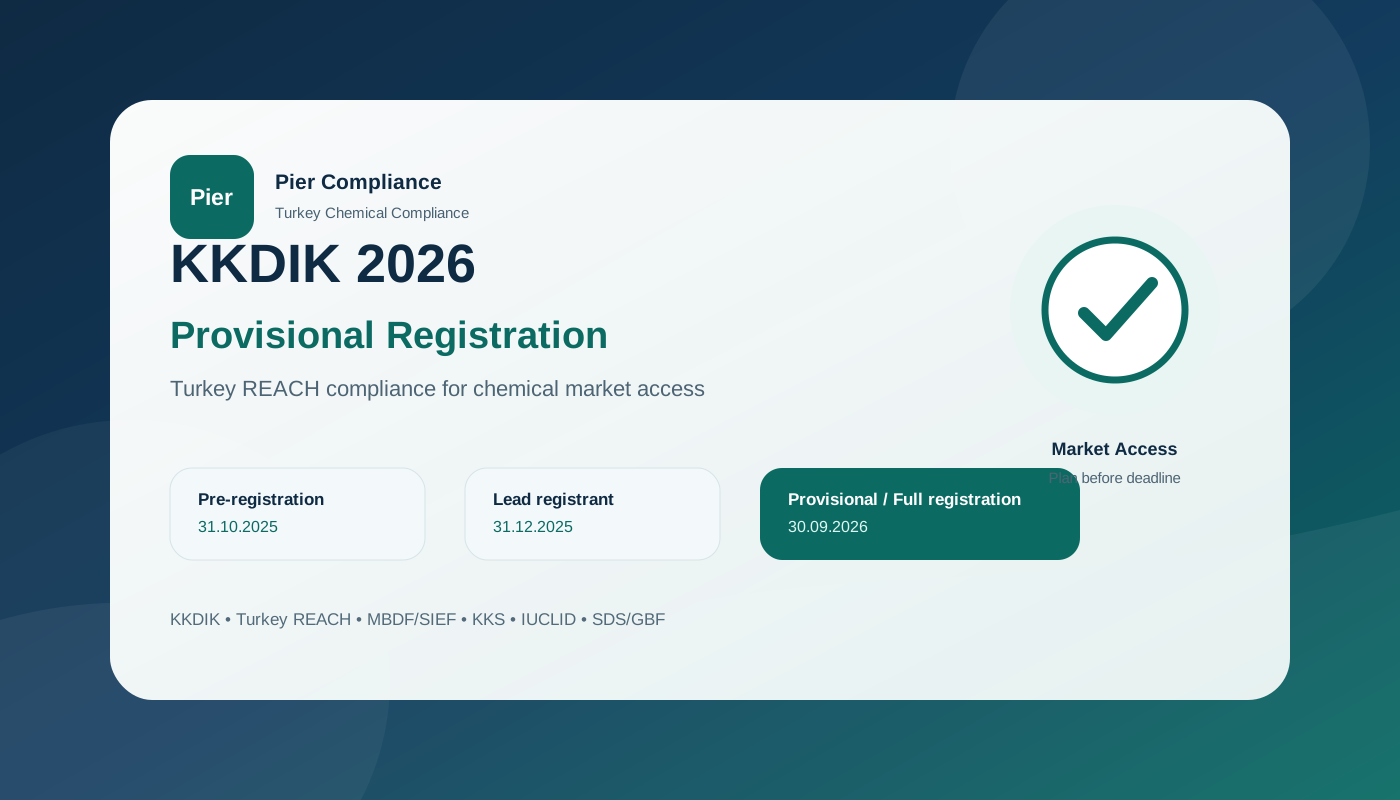
KKDIK Registration and Consulting Services 2026: Provisional Registration, Individual Filing and Turkey REACH Compliance
Pier Compliance supports companies with KKDIK 2026 pre-registration, MBDF/SIEF, lead and co-registration, individual provisional registration, full registration, KKS and IUCLID dossiers.
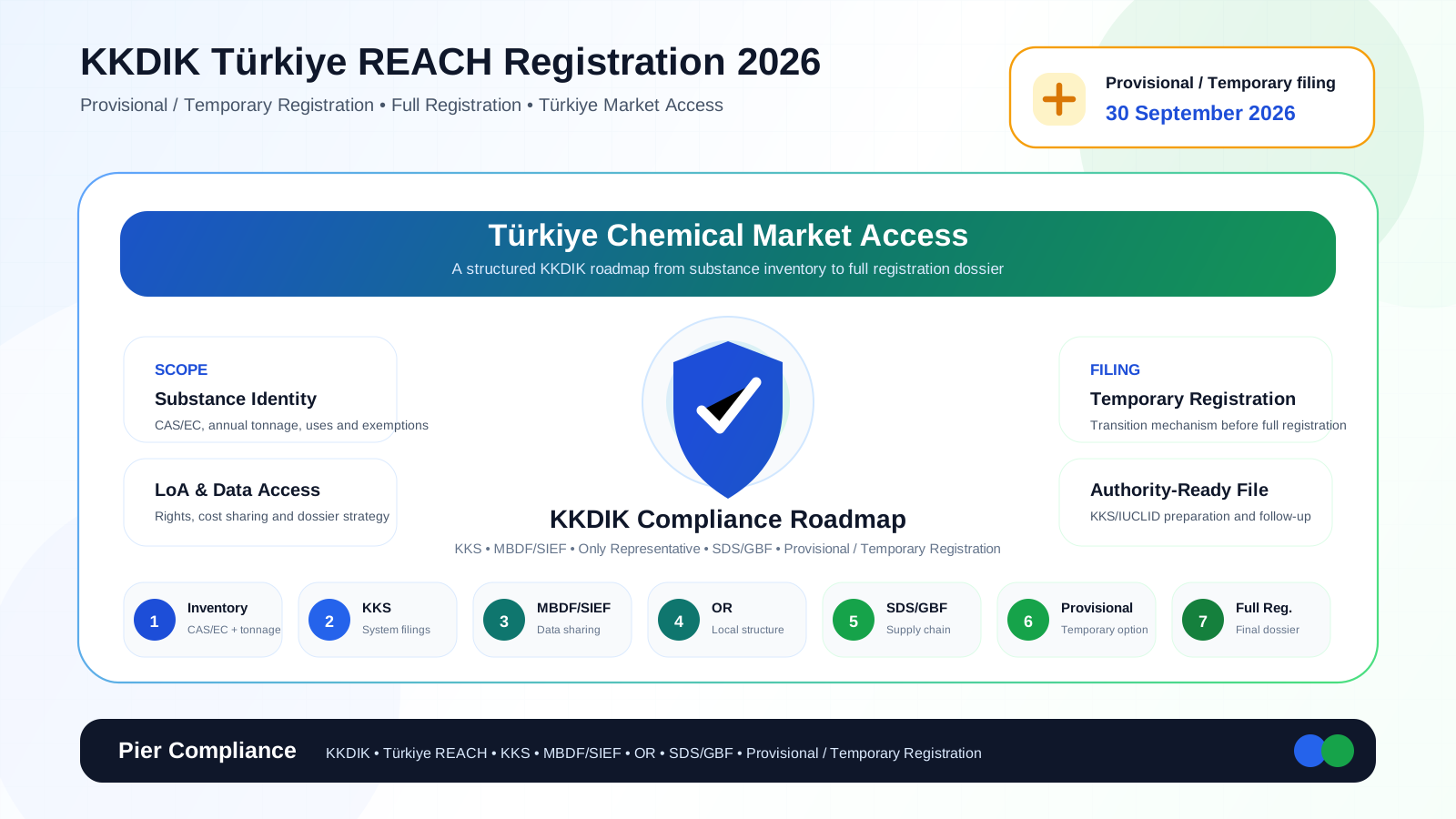
KKDIK Türkiye REACH Registration Guide 2026: Provisional / Temporary Registration, Full Registration and Market Access
A practical guide to KKDIK Türkiye REACH registration, the 30 September 2026 provisional / temporary registration deadline, Only Representative services, MBDF/SIEF, SDS, LoA and full registration strategy.
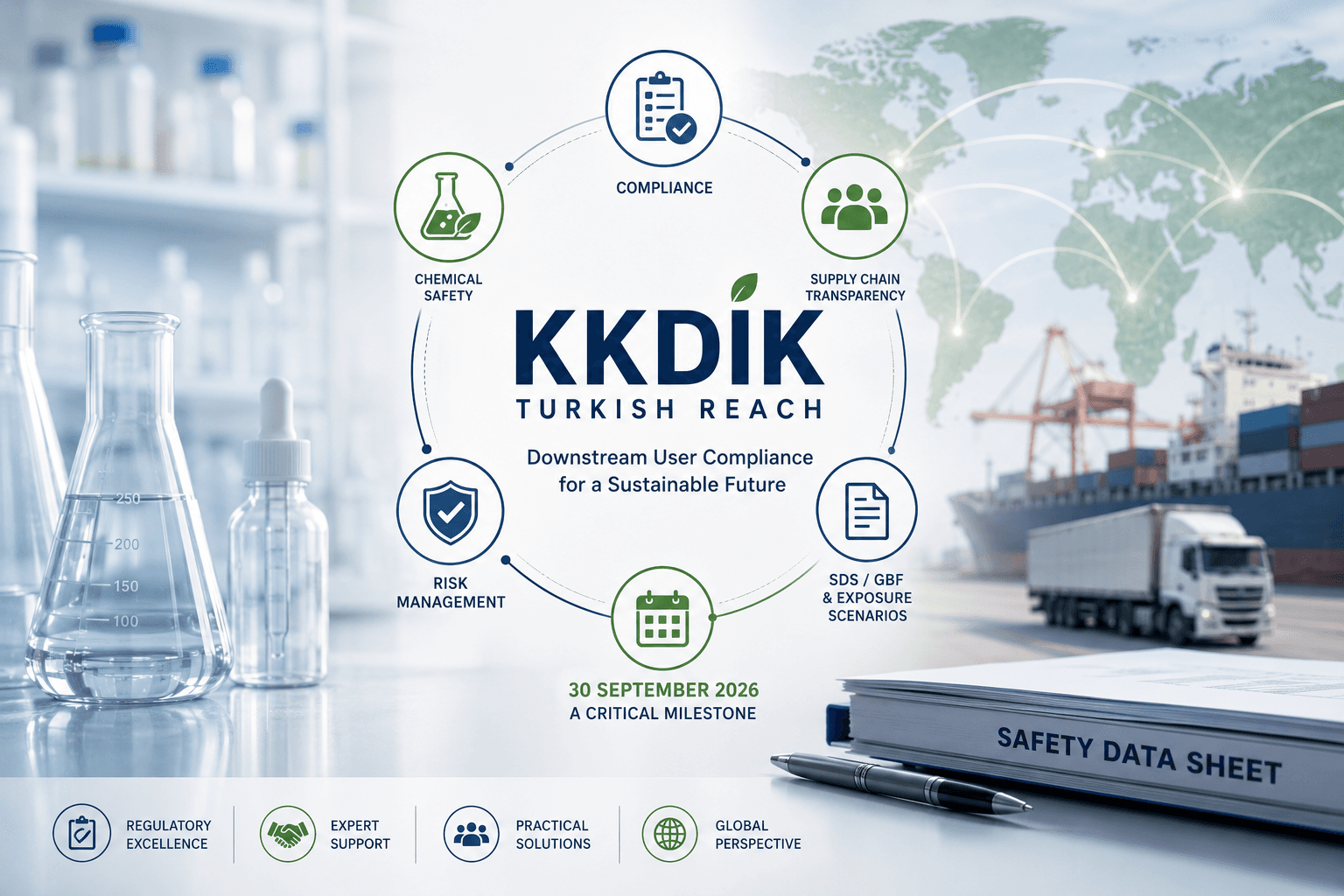
KKDIK Downstream Users: What You Need to Know Before 30 September 2026
Before the 30 September 2026 KKDIK interim registration milestone, downstream users should review use notification, SDS alignment, exposure scenarios and supply-chain roles. Pier Compliance supports role mapping and Chemical Assessment Specialist–approved SDS.