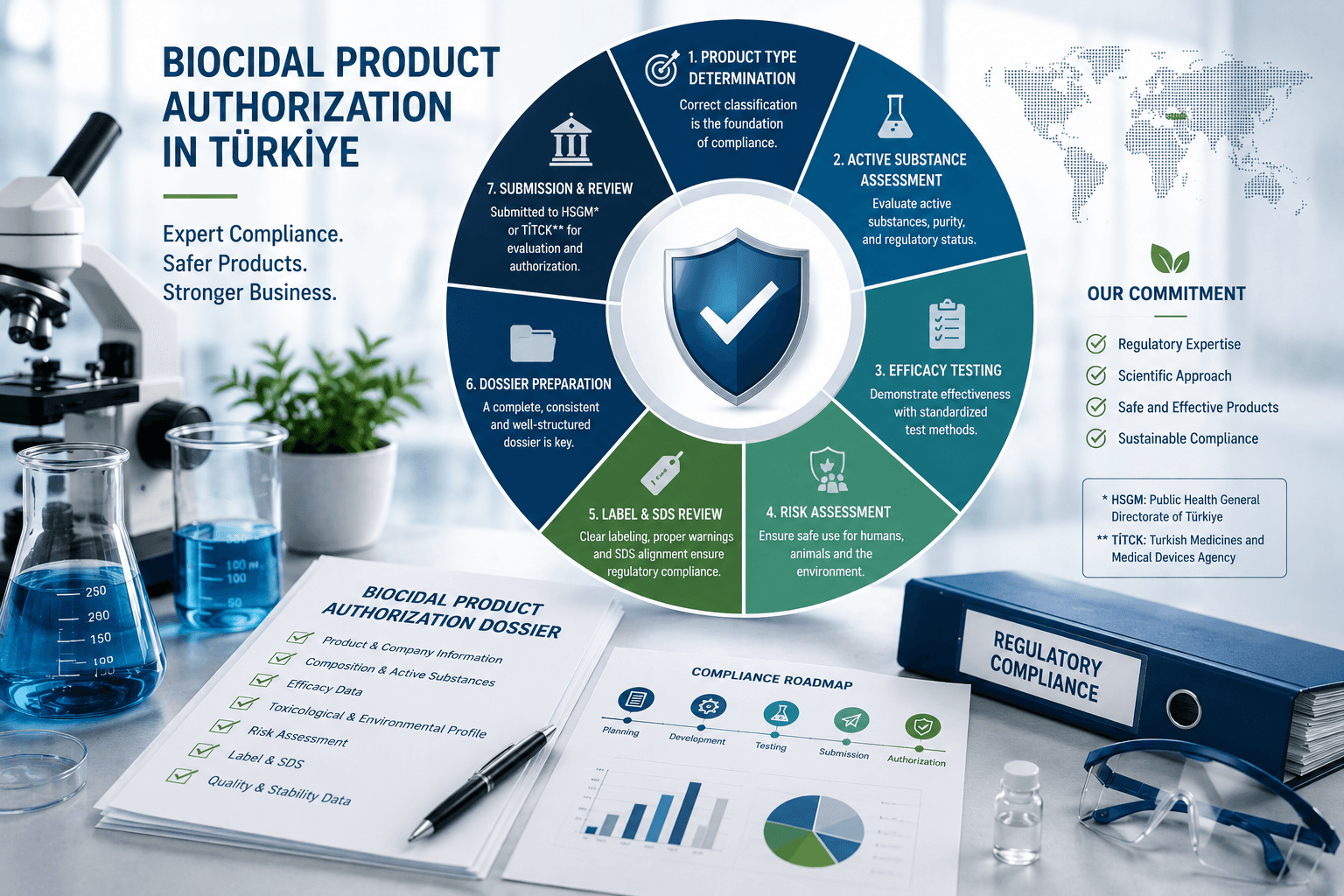
Biocidal Product Authorization in Türkiye: Technical Dossier, Active Substance and Market Access Strategy
Biocidal product authorization in Türkiye is not limited to submitting forms or uploading documents. It requires a joint assessment of the product's technical identity, active substance status, label claims, use scenarios, exposure profile and safe market access strategy. A formulation marketed as a disinfectant, repellent, preservative or pest-control product may fall within biocidal scope regardless of commercial category. The authorization pathway must be confirmed according to current authority practice on a product-specific basis.
Introduction: Authorization is more than a checklist
The Turkish biocidal framework expects scientific and regulatory consistency between formulation and market-facing claims. Manufacturers, importers and brand owners may position the same SKU across household, professional or industrial channels—each scenario implies different exposure and labelling requirements. The authorization dossier is the technical defence of those scenarios.
Where chemical compliance overlaps apply, align early with your KKDIK programme to avoid duplicate supplier data work and conflicting classifications.
Product type determination
Product type (PT) classification must be based on intended use, target organism, application area, user group, exposure and mode of action—not on marketing language alone.
Key concepts:
- PT classification and biocidal claim scope
- Target organism and use area
- Professional vs general user distinction
- Authority routing for products with direct human body contact
Borderline product risk
Some products are presented as cosmetics, detergents, medical devices, plant protection products, air fresheners or general chemicals. If labels or technical documents refer to microorganisms, harmful organisms, repellent action, disinfection, protection, inhibition or biocidal performance, biocidal scope must be assessed. Borderline misclassification can direct the project to the wrong test package and wrong authority route.
Active substance compliance
Active substance review is not a CAS/EC lookup exercise. The following elements should be reviewed together:
- List status and PT linkage
- Technical specification, purity and impurity profile
- Concentration range and technical function in formulation
- Certificate of analysis and supplier traceability
- Potential data access / Letter of Access
- Import supply-chain documentation
- Consistency with SDS classification
Product-specific assessment is required before drawing conclusions on feasibility or timelines.
Technical dossier architecture
The authorization file is a coherent technical argument, not a folder of unrelated PDFs:
Formulation → active substance → test data → label claim → SDS → risk assessment → instructions for use → packaging → market placement
The dossier must establish scientific and regulatory consistency between formulation and label claims. A weak link typically pulls the entire file into revision.
Testing and data strategy
The same test list is not appropriate for every product. Strategy should reflect PT, target claim, application method, target organism, user profile and exposure scenario.
Relevant areas:
- Physicochemical testing and active substance quantification
- Stability and shelf-life justification
- Efficacy and microbiological performance
- PT-linked irritation/toxicology/ecotoxicology where applicable
- Method selection and laboratory competence
- Alignment between test reports and label claims
- Product form impact: liquid, gel, spray, aerosol, wipe, concentrate, ready-to-use
Commissioning tests is not the same as building the data set that defends the dossier. Protocol design, sample form and claim language must be planned together.
Label, SDS and claim management
The label is a regulatory document reflecting authorization scope and safe use limits—not packaging artwork alone. SDS preparation should progress in the same language as label and risk summaries.
High-risk phrases (avoid without data and PT support):
- harmless, non-toxic, completely safe
- suitable for all surfaces, long-lasting effect, broad spectrum
- safe because natural, safe for children
- leaves no residue, 100% protection, effective against all microorganisms
Risk assessment
Risk assessment is the product's safe use strategy, not a box-ticking annex. It should address:
- Human health and environmental risk
- Professional and general user exposure; child and sensitive user scenarios
- Indoor use, spray/aerosol application
- Dermal, inhalation and potential oral exposure
- Rinse vs non-rinse use; food-contact surfaces
- Dose, contact time, residue risk
- Waste, post-use packaging and PPE requirements
Exposure scenarios must align with label instructions and SDS.
HSGM, TİTCK and application workflow
Ministry of Health, HSGM and TİTCK roles should be assessed by product type, intended use and contact nature. Avoid rigid generalisations; confirm the authority route product by product.
Typical technical sequence:
- Scope and PT pre-assessment
- Active substance and formulation analysis
- Data/test gap identification
- Label, SDS and technical document alignment
- Testing and analysis management
- Dossier architecture
- Application file preparation
- Authority review
- Additional information and revision management
- Post-authorization market readiness
- Change, renewal and inspection tracking
Post-authorization compliance
Authorization does not end compliance obligations. Changes to formulation, supplier, packaging, instructions, shelf-life claims or target organisms often trigger re-assessment. Technical files must remain audit-ready.
Pier Compliance approach
Pier Compliance addresses biocidal scope, PT determination, active substance status, technical data sets, label claims, SDS alignment and risk assessment as one programme. The objective is not filing alone but sustainable, inspection-ready market management in Türkiye.
See our biocidal product authorization service page for the full scope.
To assess the authorization pathway, technical dossier requirements and label claim risks for your biocidal product in Türkiye, you can contact Pier Compliance.
Technical Questions About Biocidal Product Authorization in Türkiye
Why is product type the primary strategic decision?
PT defines testing, exposure assumptions and label language. Wrong PT forces dossier redesign.
How does active substance status affect the file?
List status, concentration and data rights shape the dossier backbone beyond CAS identity.
Do label claims change testing?
Yes—organisms, contact time and use setting on the label must match protocol design.
How do SDS and the dossier relate?
Classification and exposure summaries must align across label and risk assessment.
What if formulation changes after authorization?
Notification or re-assessment is often required; market access may be affected.
Where does Pier Compliance add value?
From scope analysis through post-authorization change control across the technical file.
Frequently asked questions
- Why is product type the primary strategic decision in authorization?
- Product type (PT) defines the target organism scope, use setting, exposure profile and testing package. Misclassification forces redesign of efficacy protocols, risk scenarios and label claims. PT determination should therefore precede formulation lock-in.
- How does active substance status affect the authorization dossier?
- Acceptance for the relevant PT, concentration limits and data access rights form the dossier backbone. A CAS number alone is insufficient; purity profile, supplier CoA and technical function in the formulation must be reviewed together.
- Do label claims change the testing strategy?
- Yes. Target organisms, contact time, spectrum claims and use environment stated on the label should be supported by efficacy tests designed for those scenarios. Gaps between label and test reports are a frequent authority revision trigger.
- What is the relationship between SDS and the biocidal authorization dossier?
- The SDS summarises classification, exposure scenarios and safety measures. Label warnings, instructions for use and risk assessment must remain consistent with the SDS. Contradictory classification weakens dossier integrity.
- What happens if formulation or supplier changes after authorization?
- Changes to formulation, active substance supplier, concentration or label claims often require notification or re-assessment. Unplanned post-authorization changes can disrupt market access and inspection readiness.
- At which stages does Pier Compliance support biocidal authorization?
- Pier Compliance supports scope and PT analysis, active substance review, dossier gap analysis, testing strategy, label and SDS alignment, risk assessment approach, application file preparation, authority follow-up and post-authorization change management.
Related Posts
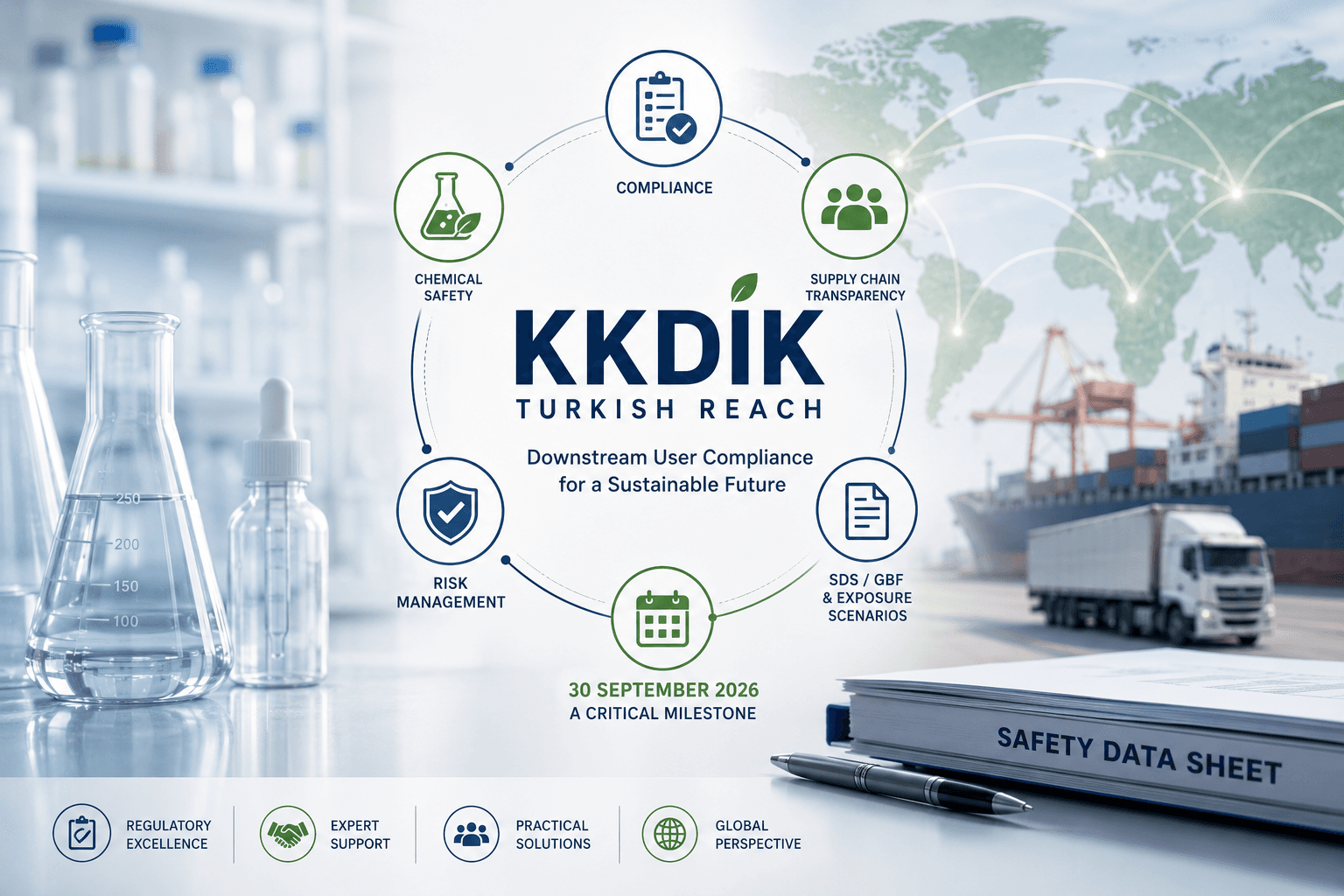
KKDIK Downstream Users: What You Need to Know Before 30 September 2026
Before the 30 September 2026 KKDIK interim registration milestone, downstream users should review use notification, SDS alignment, exposure scenarios and supply-chain roles. Pier Compliance supports role mapping and Chemical Assessment Specialist–approved SDS.

What Is an SDS (Safety Data Sheet) and Who Prepares It in Turkey?
A corporate guide to Safety Data Sheets for Türkiye: legal role, operational impact, KKDIK and SEA alignment, and why a Chemical Assessment Specialist is central to defensible SDS quality.

KKDİK Individual Interim Registration 2026: KKS Process, KDU, Official Fee and the Lead Registration Option
How the Ministry is steering KKDİK firms toward KKS individual interim registration: pre-MBDF checks, KDU input, official fee planning, and why the lead/consortium path remains open.