
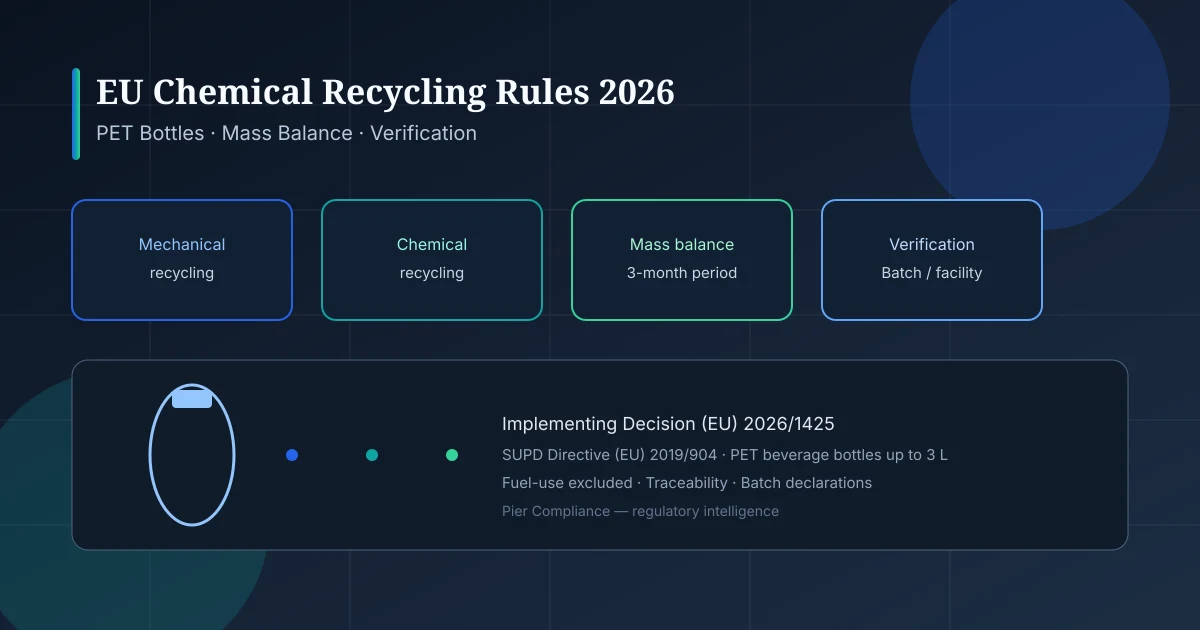
The European Commission has brought into force Implementing Decision (EU) 2026/1425, setting common rules for the calculation, verification and reporting of recycled plastic content in single-use PET beverage bottles. The first-screen legal framing must stay clear: the legal base is the Single-Use Plastics Directive (SUPD) — Directive (EU) 2019/904, not PPWR. The Decision regulates how chemical recycling and other additional methods count towards SUPD targets; it does not change the 25% (from 2025 for PET) / 30% (from 2030) targets.
The Decision was adopted on 30 June 2026, published in the Official Journal on 3 July 2026, and entered into force on 23 July 2026. It repeals Decision (EU) 2023/2683. A corrigendum of 20 July 2026 replaces the annexes. The Commission must review the methodology by 1 January 2030. This Pier analysis, dated 6 August 2026, summarises the operational reading for companies and should be read with the PPWR FAQ and EUROPEN updates: PPWR FAQ 2026, EUROPEN July 2026.
Key findings
- Legal base SUPD (EU) 2019/904 — not PPWR; purpose is calculation/verification/reporting
- 2023/2683 repealed; OJ 3.7.2026; force 23.7.2026; 20.7.2026 corrigendum replaces annexes
- Scope: PET as major component, ≤3 L; cap/lid/label/sleeve included; glass/metal with plastic caps and certain medical liquid-food bottles excluded
- Targets unchanged (25%/30%); the Decision is methodology
- Chemical recycling complements mechanical; mechanical is generally preferable
- Mass balance: max 3 months, no negative balance, facility-level, no transfer of attributed amounts between facilities; fuel-use excluded
- Batch declarations + 5-year retention; pass-through where composition is unchanged
- Third-party verification is not for all EOs; narrow scope + SME derogation
- Geography: EU/EEA first; from 21.11.2027 OECD (unless WSR Art. 45 exclusion) and non-OECD with equivalent arrangements; OECD ≠ automatic
- Türkiye: third country; no automatic acceptance — measured language
Contents
- Legal base: SUPD, not PPWR
- What the Decision does and the repeal of 2023/2683
- Timeline, corrigendum and 2030 review
- Scope: PET bottles, parts and exclusions
- Targets unchanged: a methodology Decision
- Chemical and mechanical recycling
- Calculation method and calculation points
- Mass-balance rules
- Fuel-use exclusion
- Batch declarations, retention and pass-through
- Third-party verification: who and how often
- Geographic scope: EU, OECD and non-OECD
- Measured assessment for Türkiye
- Boundaries with FCM 2022/1616 and PPWR
- Member State data collection and reporting
- What companies should do (checklist)
- Pier Compliance assessment
- Primary sources and official links
Legal base: SUPD, not PPWR
The Decision is adopted under Directive (EU) 2019/904, in particular the second subparagraph of Article 6(5) and the third subparagraph of Article 13(4). SUPD sets minimum recycled plastic content targets for single-use plastic beverage bottles listed in Part F of its Annex; Member States report data each calendar year.
This distinction matters in practice. Packaging programmes and PPWR (EU) 2025/40 may sit in the same internal file, but 2026/1425 is not a PPWR implementing act. PPWR Article 7(8) may be referenced in future methodology alignment debates; this Decision’s product-category boundary is PET bottles and must be read on its own legal base. In Pier Compliance’s assessment, the most common error is labelling the Decision as “PPWR recycled-content rules” and wiring it into the wrong procedure.
What the Decision does and the repeal of 2023/2683
The Decision lays down rules for the calculation, verification and reporting of data on recycled plastic content in single-use plastic beverage bottles. Decision (EU) 2023/2683 mainly relied on data generated under Regulation (EU) 2022/1616 and on suitable technologies under that Regulation. To allow additional recycling methods — including chemical recycling and mixed pre-/post-consumer inputs — to contribute to SUPD targets, substantial additions were needed, notably mass-balance accounting. Decision 2023/2683 is therefore repealed, and references are construed as references to the new Decision.
The Commission’s 30 June 2026 communication states that the rules aim at transparency, a level playing field and investment certainty for plastics recycling. The methodology is designed to apply across recycling technologies, including chemical and mechanical routes, to help Member States meet SUPD recycled-content targets.
Timeline, corrigendum and 2030 review
- Adoption: 30 June 2026
- Official Journal: 3 July 2026 (OJ L, 2026/1425)
- Entry into force: twentieth day after publication → 23 July 2026
- Corrigendum: 20 July 2026 (OJ L, 2026/90601) — annexes replaced
- Review: by 1 January 2030 at the latest (Article 10)
- Pier publication date: 6 August 2026
For companies, calculation formulas, reporting tables, quality-check templates, certificate elements and declaration formats must be read from the post-corrigendum annexes. Supply chains that keep working from superseded annex PDFs risk data errors. The 2030 review may consider commercial-scale technology roll-out and, where appropriate, alignment with PPWR Article 7(8); it does not suspend today’s duties.
Scope: PET bottles, parts and exclusions
A PET bottle is a beverage bottle manufactured from polyethylene terephthalate as the major component. A beverage bottle is a single-use plastic beverage bottle with a capacity of up to three litres, including its cap, lid, label and sleeve, if any.
Because the targets promote market uptake of recycled plastic, calculations focus on the weight of plastic parts. Non-plastic parts (for example a paper label) are typically a small share and are excluded from the plastic-weight denominator; any recycled plastic in labels or sleeves is included in the recycled-plastic numerator.
Exclusions:
- Glass or metal beverage bottles that have plastic caps and lids
- Beverage bottles intended and used for food for special medical purposes in liquid form as defined in Article 2(2)(g) of Regulation (EU) No 609/2013
Scope analysis must not rest on “it looks like PET”; it needs major-component, volume, intended use and component-inventory checks.
Targets unchanged: a methodology Decision
The SUPD targets remain: 25% recycled plastic content in PET bottles from 2025, and 30% from 2030 for the relevant single-use plastic beverage bottles. Decision 2026/1425 does not rewrite those thresholds. What changes — especially for chemical recycling and mass-balance pathways — is how content is counted, verified and reported.
Customer questionnaires often blur this point. Readings such as “new Decision, higher target” or “chemical recycling now mandatory” are wrong. The correct reading: targets stay fixed; evidence and calculation discipline tighten.
Chemical and mechanical recycling
Mechanical recycling remains the most widely used method: sorting, washing, shredding and remoulding without changing the chemical structure of the plastic input. Food residues, additives and mixed materials can reduce mechanical recyclability. Chemical recycling breaks plastics into smaller molecules that can become feedstocks for new plastics or other chemicals, complementing mechanical routes for difficult streams and high-quality uses such as food-contact packaging.
The Decision’s recitals are explicit: chemical recycling should complement mechanical recycling; mechanical methods are in general preferable environmentally. Waste that can be recycled mechanically should in principle not enter chemical recycling if mechanical recycling can produce recyclates with similar quality or performance. In Pier Compliance’s assessment, technology choice should not be reduced to “does it count?”; it should weigh waste hierarchy, quality need and traceability cost.
Calculation method and calculation points
The proportion is the weight of recycled plastic in PET bottles placed on a Member State market in a given year, divided by the weight of plastic in those bottles, expressed as a percentage (Annex I formulas).
The final calculation point is placement on a Member State market. Because recycled content cannot be measured analytically there in a reliable way, intermediate calculation points are required whenever material stemming wholly or partly from eligible material changes chemical or physical composition. For mechanical recycling and certain suitable or novel technologies under Regulation (EU) 2022/1616, the declaration-chain percentage × part weight may be used. Where that route does not apply, Articles 6–7 mass balance apply. For mixed pathways, mass balance applies from the stage at which mixing occurs.
Mass-balance rules
Mass balance determines attributed amounts where eligible material is used with other inputs and output proportions are unknown. Core operational rules:
1. Maximum period: three months
2. No negative balance: overdraft is never allowed; a positive balance may be carried forward
3. Facility level: each facility keeps its own accounts
4. No transfer of attributed amounts between facilities or companies (physical movement of material remains possible with documentation ensuring traceability)
5. Once mass balance starts at a step, it continues downstream because proportions are no longer known
6. Where both inputs and outputs are polymers, additional reallocation of attributed amounts is not necessary and not allowed
Attributed amounts are constrained by fuel/loss deductions, chemical-traceability ceilings and multi-output allocation rules. Process-specific operational data must be representative for the period considered.
Fuel-use exclusion
The Decision adopts a fuel-use excluded approach. At each calculation point, eligible material processed into fuels or losses is deducted from recycled content. For dual-use liquid or gaseous outputs, the share that will become fuel does not count; solid dual-use outputs (such as char) are taken fully out of the calculation because they are not expected to be processed into high-value non-fuel products at relevant scale. This preserves alignment with the Waste Framework Directive definition of recycling: energy recovery is not recycling.
Batch declarations, retention and pass-through
Economic operators must issue a declaration for each batch supplied to customers, using Annex V (Parts A, B and C) as relevant. Supplier declarations must be kept for at least five years. Operators that do not change chemical or physical composition and do not mix materials need not generate a new declaration; they only transmit received declarations. Along mass-balance pathways, certificates from the last chemical-recycling step are handed down the chain, usually to fillers; Member States collect declarations and certificates from operators placing bottles on the market.
Third-party verification: who and how often
Third-party verification is not for all economic operators. Article 8(5) requires annual, facility-level, on-site verification for operators that process material which does not consist of polymers at both the input and the output stage and that calculate data under Article 6(3). For SMEs, verification takes place every three years. Certificates are generally valid for one year, or three years for SMEs, and are recognised by all Member States. The verifier is a conformity assessment body accredited under Regulation (EC) 765/2008; independence and competence requirements apply.
Pier Compliance does not perform this verification; it is not an accredited verifier or laboratory. Its role is to help separate which operators fall in or out of scope and to structure documentation readiness.
Geographic scope: EU, OECD and non-OECD
First phase: recycled plastic produced in the Union (and in a verifiable EEA context) under EU environmental rules counts.
From 21 November 2027:
- Post-consumer plastic waste recycled (including sorted) in countries to which the OECD Decision applies may also count — unless the assessment and decision under Articles 45(5) and (6) of Regulation (EU) 2024/1157 conclude otherwise
- Non-OECD countries count only where the Union has concluded agreements or arrangements ensuring treatment equivalent to EU human-health and environmental-protection standards (notably the Waste Framework Directive and relevant PPWR elements), with a comprehensive national waste-management framework
OECD membership is not automatic acceptance. The date threshold and the WSR assessment must be read together. Being able to import recycled plastic is not the same as counting it towards the mandatory target.
Measured assessment for Türkiye
For the Decision’s geographic counting rules, Türkiye is a third country. There is no automatic “counts towards the EU target” outcome. Counting depends on conditions such as the OECD pathway at the relevant date plus Article 45 outcomes, or an equivalent-standards arrangement with the Union. For companies exporting PET bottles, rPET or chemical-recycling intermediates from Türkiye into the EU, practical implications include:
1. Separate SUPD target counting from customs/import and FCM regimes
2. Avoid “OECD/equivalent = automatic green light” claims
3. Gather facility-level waste-management and traceability evidence
4. Meet EU customers’ declaration and certificate requests under mass-balance rules
Language should stay measured: neither a blanket “Türkiye excluded” nor a blanket “Türkiye included” sentence replaces the Decision’s conditions.
Boundaries with FCM 2022/1616 and PPWR
Regulation (EU) 2022/1616 sets food-contact recycled plastic compliance and declaration chains. Decision 2026/1425 allows those percentages to be used for SUPD calculations to minimise administrative burden, while requiring geographic-origin information to be added. Definitional differences (plastic / recycled plastic) may exist; they are not a reason to ignore the chain.
PPWR (EU) 2025/40 is the general packaging regime; the methodology in this Decision applies only to the PET-bottle category. PPWR Article 7(8) may appear in future alignment discussions; today, the SUPD file and the PPWR file must not be collapsed. For packaging EPR and PPWR readiness: EPR / packaging. For substance and SDS consistency: SDS preparation, EU REACH.
Member State data collection and reporting
Member States collect plastic and recycled-plastic weight data from economic operators placing PET bottles on their market; verify on a risk basis; calculate the annual proportion; report in the Annex II format; and submit the Annex III quality-check report. Only data calculated, collected and verified under this Decision may go to the Commission. Where processing occurs in a third country, Member States must also verify the accuracy of accompanying information.
What companies should do (checklist)
1. Label the legal base as SUPD; separate it from the PPWR file
2. Map PET-bottle scope (≤3 L, PET major component, cap/label/sleeve) and exclusions
3. Communicate that 25%/30% targets are unchanged; focus on methodology change
4. Distinguish mechanical, chemical and hybrid routes in the supply chain
5. Define calculation points (composition change / mixing)
6. Implement mass-balance controls: 3 months, no negative balance, facility level, no attributed-amount transfer
7. Apply fuel-use exclusion and dual-use output classification
8. Build Annex V batch-declaration templates and a 5-year archive; clarify pass-through roles
9. Read third-party verification scope narrowly; separate SME frequency and certificate validity
10. Update the geographic-origin matrix (EU/EEA → 21.11.2027 OECD → equivalent non-OECD)
11. Do not assume automatic acceptance for Türkiye or other third-country scenarios
12. Link the 2022/1616 declaration chain to SUPD calculations; use post-corrigendum annexes
13. Prepare data quality for Member State reporting calendars
14. Put the 1 January 2030 review on the monitoring list; do not defer today’s compliance
Avoid two extremes: (1) treating the Decision as PPWR and applying the wrong checklist; (2) saying “targets are the same” and neglecting mass balance, declarations and geography.
Pier Compliance assessment
In Pier Compliance’s assessment, Decision 2026/1425 is not a panic text; it is a methodology update that keeps SUPD targets traceable, verifiable and comparable in the chemical-recycling era. Highest value sits in the SUPD/PPWR separation, unchanged targets, mass-balance disciplines, narrow verification scope, and the date-/condition-dependent geographic counting rules.
Pier Compliance acts as an independent regulatory compliance advisor helping with scope analysis, role mapping and documentation structure. It is not a verifier, laboratory, accredited certifier or Commission-authorised body, and it does not issue official conformity decisions or guarantees. This article is not legal advice; the primary texts prevail.
Is your PET bottle recycled-content file ready?
Review SUPD targets, chemical-recycling mass-balance rules, declaration chains and geographic counting scenarios together. Pier Compliance helps separate Decision (EU) 2026/1425 from the PPWR agenda and clarify priority actions.
Related: PPWR FAQ 2026, EUROPEN July 2026, SDS preparation, EU REACH.
Primary source
- Document: Commission Implementing Decision (EU) 2026/1425 of 30 June 2026
- Subject: Calculation, verification and reporting of recycled plastic content in single-use PET beverage bottles under the SUPD; repeal of Decision (EU) 2023/2683
- Institution: European Commission
- Pier publication date: 6 August 2026
- Access date: 6 August 2026
Official sources
- European Commission press release — IP/26/1467
- Commission clarifies rules on plastic bottles recycling
- DG Environment — Implementing Decision publication page
- EUR-Lex — Implementing Decision (EU) 2026/1425
Frequently asked questions
- Is this Decision part of PPWR?
No. Implementing Decision (EU) 2026/1425 was not adopted under the Packaging and Packaging Waste Regulation (PPWR) (EU) 2025/40. Its legal base is the Single-Use Plastics Directive (SUPD) (EU) 2019/904, in particular Articles 6(5) and 13(4). Thematic overlap with packaging policy does not change the fact that this act is the SUPD methodology for calculating, verifying and reporting recycled content in PET bottles.
- What does Implementing Decision (EU) 2026/1425 do?
It lays down common rules for the calculation, verification and reporting of recycled plastic content in single-use PET beverage bottles. For the first time it sets out detailed mass-balance accounting for chemical recycling and mixed waste inputs. It repeals Decision (EU) 2023/2683 and does not rewrite the SUPD percentage targets.
- What is the legal base?
The legal base is Directive (EU) 2019/904 (SUPD), specifically the second subparagraph of Article 6(5) and the third subparagraph of Article 13(4). Within that framework, the Decision provides the methodology Member States need to monitor minimum recycled plastic content targets for PET bottles and to report data to the Commission.
- When was it published and when did it enter into force?
The Decision was adopted on 30 June 2026, published in the Official Journal on 3 July 2026 (OJ L, 2026/1425), and entered into force on the twentieth day thereafter — 23 July 2026. A corrigendum of 20 July 2026 replaced the annexes; companies must use the corrected annex texts.
- What did the 20 July 2026 corrigendum change?
The corrigendum (OJ L, 2026/90601, 20.7.2026) replaces the annexes to Implementing Decision (EU) 2026/1425. Calculation formulas, reporting formats, quality-check templates, verification-certificate elements and declaration templates must be read from the updated annexes. Working from superseded annex copies creates data-error and Member State reporting risk; bind internal procedures to the corrected texts.
- Did the SUPD 25% and 30% targets change?
No. The SUPD minimum recycled-content targets — 25% from 2025 for PET bottles and 30% from 2030 for the relevant bottles — are unchanged by this Decision. The Decision is a methodology instrument: it regulates how content is calculated, verified and reported; it does not raise or lower the percentage thresholds.
- Which bottles are in scope?
The scope covers single-use plastic beverage bottles with polyethylene terephthalate as the major component and a capacity of up to three litres. Caps, lids, labels and sleeves (if any) form part of the bottle; plastic parts count towards the weight. Glass or metal bottles with plastic caps, and certain liquid food-for-special-medical-purposes bottles, are excluded.
- Does chemical recycling replace mechanical recycling?
No. The Decision and Commission communications stress that chemical recycling complements mechanical recycling. Mechanical methods are in general preferable from an environmental perspective; waste that can be recycled mechanically should in principle not enter chemical recycling where mechanical routes can deliver similar quality or performance. Chemical recycling addresses streams that are difficult or impossible to recycle mechanically.
- What is mass balance accounting?
Mass balance is the set of calculation rules used to determine attributed amounts where eligible material is processed together with other inputs and the proportions in outputs are not known. The weight of eligible input must balance the amounts attributed to outputs and losses. In chemical recycling the polymer structure is broken, so proportions are generally unknown and mass balance is required.
- What are the period, negative-balance and facility rules?
Mass-balance accounting may cover a maximum period of three months. A negative account of attributed amounts is never permitted; a positive balance may be carried into the next period. Accounting applies at facility level; attributed amounts must not be transferred between different facilities of a company or between companies. Physical movement of material remains possible with documentation ensuring traceability.
- Does fuel use count as recycled content?
No. The Decision follows a “fuel-use excluded” approach: eligible material processed into fuels or losses is deducted from recycled-content calculations. For dual-use liquid or gaseous outputs, the share that becomes fuel does not count; solid dual-use outputs (for example char) are taken fully out of the calculation. This preserves alignment with the Waste Framework Directive definition of recycling.
- What are the batch-declaration and retention duties?
Economic operators must provide a recycled-content declaration for each batch of material supplied to customers, using the Annex V templates. Declarations received from suppliers must be kept for at least five years. Operators that do not change chemical or physical composition and do not mix materials need not issue a new declaration; they only pass on supplier declarations (pass-through).
- Must every economic operator undergo annual third-party verification?
No. Annual facility-level third-party verification applies to specific operators that process material which does not consist of polymers at both input and output stages and that calculate data under Article 6(3) mass balance. It does not apply automatically to all economic operators. For SMEs, verification takes place every three years; certificates are generally valid for one year, or three years for SMEs.
- Which geographic origins count towards the target?
In a first phase, recycled plastics from the Union and EEA — where compliance with EU environmental rules can be fully verified — count. From 21 November 2027, recycled plastic from OECD Decision countries may also count unless excluded under Waste Shipment Regulation Article 45. Non-OECD material counts only where arrangements ensure equivalent human-health and environmental-protection standards.
- Does OECD membership mean automatic acceptance?
No. Recycled plastic from OECD countries does not count automatically before 21 November 2027; even after that date it may be excluded if the Waste Shipment Regulation (EU) 2024/1157 Article 45(5)–(6) assessment so concludes. An “OECD = automatic acceptance” assumption is inconsistent with the Decision; country-level monitoring is required.
- Does recycled plastic from Türkiye count automatically?
No. Türkiye is a third country. Without falling within the OECD Decision pathway (subject to Article 45) or an arrangement ensuring equivalent standards with the Union, there is no automatic acceptance for SUPD target counting. Import and food-contact rules are separate regimes; counting towards the target is not the same as market access. Measured, country- and facility-level assessment is required.
- When will the Decision be reviewed?
Under Article 10, the Commission shall review this Decision by 1 January 2030 at the latest. The review may consider technology developments, mass-balance allocation rules and, where appropriate, alignment with PPWR Article 7(8). Waiting until 2030 before preparing is not advisable; the methodology applies now.
- What happened to Decision (EU) 2023/2683?
Implementing Decision (EU) 2023/2683 is repealed. References to the repealed Decision are to be construed as references to Decision (EU) 2026/1425. The earlier methodology relied mainly on suitable technologies under Regulation (EU) 2022/1616; the 2026 Decision widens the framework with additional rules for chemical recycling and mass balance.
- When must a calculation point be established?
A calculation point is required whenever the chemical or physical composition of material stemming wholly or partly from post-consumer plastic waste changes — in particular when it is mixed with virgin polymers, additives or non-post-consumer plastic waste. The final calculation point is when the PET bottle is placed on a Member State market; data from earlier points feed that result.
- What is eligible material?
Eligible material means post-consumer plastic waste and material stemming from it. For target counting, recycled plastic covers material derived from post-consumer plastic waste; pre-consumer scrap from manufacturing processes generally falls outside that definition. Waste from products placed on the market that expired before consumer sale may still be treated as post-consumer.
- How are Regulation (EU) 2022/1616 declarations used?
For mechanical recycling and certain suitable or novel technologies, the percentage stated in the Annex V Part C addition to the 2022/1616 declaration of compliance may be multiplied by the weight of the relevant bottle part. Where mass balance is required, Articles 6–7 apply. Despite slight definitional differences, that information chain should be used and completed with geographic-origin data.
- What must Member States report?
Member States must annually calculate the weight of plastic and recycled plastic in PET bottles placed on their market and the resulting proportion; report in the Annex II format; and submit the quality-check report in the Annex III format. Only data calculated, collected and verified in accordance with this Decision may be reported. Risk-based verification is a Member State responsibility.
- What should companies do now?
Separate SUPD from PPWR; map PET-bottle scope and exclusions; distinguish mechanical and chemical routes; implement mass-balance facility and period controls; apply fuel-use exclusion; build batch declarations and five-year archives; read verification scope narrowly; track geographic origin and Türkiye scenarios. The detailed checklist is in the article body.
- How does Pier Compliance support companies on this Decision?
Pier Compliance provides independent regulatory compliance advisory on scope analysis, supply-chain role mapping and documentation structure under EPR/packaging, SDS preparation and EU REACH. It is not a verifier, laboratory, accredited certifier or Commission-authorised body, and it does not issue official conformity decisions or guarantees. Contact.