
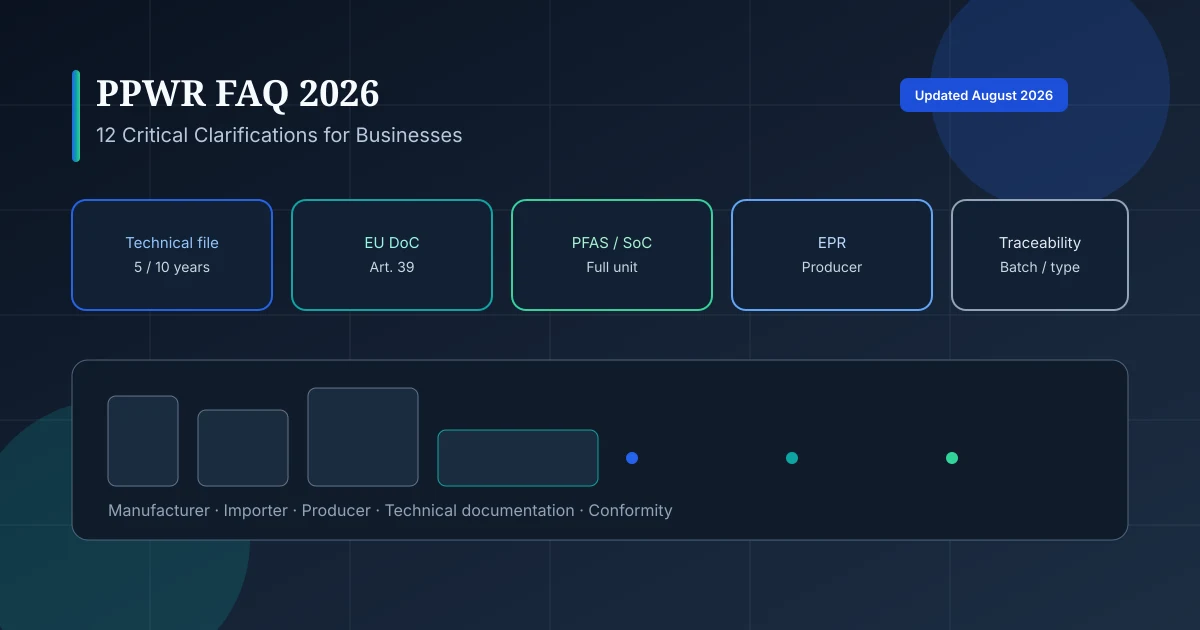
The European Commission DG Environment’s Packaging and Packaging Waste Regulation (PPWR) Frequently Asked Questions, second edition (August 2026, KH-01-26-068-EN-N), clarifies the operational questions companies confuse most. The direct answer is this: the FAQ is not new binding legislation. It is intended to assist application of Regulation (EU) 2025/40, reflects the authors’ views only, and the European Commission is not liable for consequences stemming from reuse of the publication. Legal obligations must be read from the Regulation and any relevant secondary measures.
PPWR entered into force on 11 February 2025; the general application date is 12 August 2026. Provisions such as recyclability, recycled-content targets, certain packaging bans and reuse targets may apply later. This Pier article is published on 6 August 2026 and summarises the business-critical clarifications in the second edition. Read it together with the EUROPEN July 2026 packaging agenda: EUROPEN July 2026 PPWR.
Key findings
- The FAQ is not binding; it assists application of (EU) 2025/40 (authors’ views)
- Stock: pre-application stock need not be destroyed/relabelled; already placed stock may remain
- Traceability: type/batch/serial or equivalent is enough; not every component must be marked
- Technical file: 5 years (single-use) / 10 years (reusable); drawing it up cannot be delegated
- PFAS: concentration limits, not a ban; whole unit includes inks/glues; no CAS list
- Enforcement: first require ending non-compliance; no general micro-enterprise EPR exemption
Contents
- Legal nature of the PPWR FAQ
- Scope and application timeline
- Packaging types: sales, grouped and transport
- Who is the manufacturer of transport packaging?
- When is a brand owner the manufacturer?
- Manufacturer versus producer
- Stock and the 12 August 2026 transition
- Serial, batch and traceability
- Supplier versus manufacturer
- Technical file: content, 5/10 years and non-delegation
- Importer obligations
- PFAS, inks/glues and substances of concern
- EN 13428 and environmental claims
- Transport conformity, DoC language and enforcement
- Micro-enterprises, EPR and the technical-file distinction
- What companies should do (14 steps)
- Pier Compliance assessment
- Primary source and official links
Legal nature of the PPWR FAQ
The FAQ is intended to help economic operators, national authorities and citizens apply the PPWR. Its legal notice states that the document was prepared for the Commission but reflects the authors’ views only, and that the Commission is not liable for consequences of reuse.
That distinction matters in practice. The FAQ interprets grey areas; it does not create a new ban, fee or deadline. The correct company reading is to use the FAQ as decision support and verify final conformity outcomes against Regulation (EU) 2025/40 and applicable implementing texts.
According to Pier Compliance’s assessment, the most common error is treating FAQ sentences as automatic exemptions or automatic bans. The document guides operational questions on stock, traceability, roles and PFAS, but national enforcement plans and product-specific evidence needs remain. Internal procedures should label “source = FAQ / binding source = Regulation”.
Scope and application timeline
PPWR applies to all packaging placed on the EU market — empty or filled — and to packaging waste generated in the EU, regardless of material and whether produced in the Union or imported. Items that form an integral part of a product and are disposed of with it are excluded.
The timeline is staggered: 11 February 2025 entry into force, 12 August 2026 general application; recyclability, recycled content, certain bans and reuse targets progress on later dates. PFAS limits for food-contact packaging under Article 5(5) are linked to the general application date.
The practical implication is that a single “12 August checklist” will not close every PPWR duty. Labelling, design-for-recycling, reuse and EPR reporting calendars must be tracked separately. The second edition strengthens near-term operational answers (stock, identification, technical file, importer duties, enforcement) without cancelling 2030 targets.
Packaging types: sales, grouped and transport
The FAQ defines sales, grouped and transport packaging separately. Transport packaging forms the outer layer of packaged products, prevents damage, facilitates handling and is often discarded in commercial or industrial settings. E-commerce packaging is a special form of transport packaging for distance sales and is often discarded at the consumer’s premises.
This is not mere vocabulary: manufacturer and producer roles can depend on packaging type. Misclassification misassigns DoC and EPR responsibility.
Sales packaging is the sales unit offered to consumers; grouped packaging supports stockkeeping or shelf display; transport packaging is the outer handling and protection layer. One shipment may combine all three. Inventory work should therefore map type, brand, supplier and role for each item — not stop at “do we have cartons?”.
Who is the manufacturer of transport packaging?
The manufacturer of transport packaging is identified when the empty packaging has reached its final form: it can be used as transport packaging without further components. Using tape, wrap, boxes and pallets together does not mean each item is not already in final form.
The FAQ’s critical point: one shipment may contain packaging from multiple manufacturers, and each must provide the technical documentation and information needed for the EU declaration of conformity when placing packaging on the market. For unbranded generic transport packaging, the decisive criterion is who places the order and decides design specifications; where a name or trademark appears, that economic operator is the manufacturer.
Examples in the FAQ are concrete: for a branded cardboard box, the brand owner may be the manufacturer; for unbranded standardised boxes, the physical manufacturer is. Stretch wrap sold on a roll is generally manufactured by the wrap producer; the company that later wraps pallets does not automatically become manufacturer. A logistics sticker for shipment is not branding by itself.
When is a brand owner the manufacturer?
Where a person has packaging or a packaged product designed or manufactured under its own name or trademark, that person is the manufacturer even if another operator physically manufactures or fills it. If the economic operator is a micro-enterprise and the supplier is located in the same Member State, the supplier may become the manufacturer under the specific exception.
Where one company’s name and another’s trademark both appear, the FAQ looks to who determines packaging design and specifications. A licensor whose trademark appears but who does not determine packaging characteristics should not automatically be treated as manufacturer; contractual analysis is required.
Manufacturer versus producer
Manufacturer is the economic operator that places packaging on the market under PPWR conformity rules and carries technical-file and DoC responsibility. Producer is the EPR actor that first makes packaging available on a Member State territory; depending on packaging type and selling model, that may be the manufacturer, importer or distributor.
The two roles may coincide, but they need not. Pier Compliance’s assessment is that companies should map roles before producing document packs; otherwise they risk a “DoC ready, EPR missing” failure — or the reverse.
Stock and the 12 August 2026 transition
The FAQ’s (NEW) stock answer is clear: packaging already produced and held in stock but not yet placed on the market by 12 August 2026 does not have to be destroyed, remanufactured or re-labelled. Article 15(5)–(6) identification information may be provided by an accompanying document. Packaging placed on the market before 12 August 2026 may remain on the market even if non-compliant with PPWR.
For packaging manufactured after 12 August 2026, an accompanying document may be used only where it is not possible to affix the identifier and manufacturer details on the packaging itself. Stock policy should not swing to “destroy everything” or “change nothing”; the decisive fact is date of placing on the market.
Where supplier information is missing for packaging manufactured before 12 August 2026, the FAQ expects the manufacturer to make best efforts: request data from the former supplier, from a successor after merger/acquisition, or perform its own assessments. That does not make undocumented packaging automatically compliant, nor does it mandate wholesale destruction.
Serial, batch and traceability
Article 15(5) requires packaging to bear information enabling unique identification, such as a type, batch or serial number or another equivalent element. The purpose is to link packaging to technical documentation and the Declaration of Conformity. The FAQ does not require every component of a packaging unit to be marked; for a yoghurt cup with lid and sleeve, information on one component of the sales packaging can suffice.
Where size or nature prevents affixing, an accompanying document may be used. For common standardised items such as adhesive tapes, generic plastic bags or desiccant bags, traceability is normally at production-batch level rather than each individual unit.
Supplier versus manufacturer
Suppliers of packaging or packaging materials are generally not manufacturers. The exception is where the manufacturer is a micro-enterprise and the supplier is located in the same Member State. Type/batch/serial obligations fall on manufacturers; in practice, suppliers may ensure identifiers at production stage.
Under Article 16, suppliers must provide manufacturers with all information and documentation necessary to demonstrate conformity and cannot refuse. Drawing up the DoC is generally not the supplier’s duty; the company placing packaging or packaged products on the market bears overall compliance responsibility.
Technical file: content, 5/10 years and non-delegation
Manufacturers and importers must keep Annex VII technical documentation for 5 years for single-use packaging and 10 years for reusable packaging. The documentation must at least include conceptual design, manufacturing drawings and materials of components. A supplier retaining design information and releasing it to authorities on request does not replace the manufacturer’s retention duty.
According to the FAQ, the obligation to draw up technical documentation cannot be delegated. Conformity assessment may be carried out on the manufacturer’s behalf by a laboratory or certification scheme; the DoC may be drafted by an authorised representative under a written mandate, while overall responsibility remains with the manufacturer. An authorised representative may keep the DoC and technical documentation available to authorities.
This distinction is often blurred in contracts. Laboratory testing can support conformity assessment, but a “lab writes the technical file, we only sign” model does not match the FAQ’s responsibility line. Suppliers provide Article 16 information; manufacturers process it into their own technical documentation and retain it. Commercial confidentiality does not cancel retention; it must be managed under EU and national law.
Importer obligations
From 12 August 2026, an importer must ensure that the third-country manufacturer has carried out the conformity assessment and drawn up the Declaration of Conformity, complied with Article 15(5)–(6), and that required documents accompany the packaging. Importers must also indicate their name, trademark and contact details on the packaging or an accompanying document. Generic or unbranded imported materials (for example paper sheets) do not remove documentation and compliance responsibility.
PFAS, inks/glues and substances of concern
The FAQ stresses that PPWR does not establish a PFAS ban but sets maximum concentration levels. The limits do not distinguish intentionally added from unintentionally present PFAS. They apply to the packaging unit as a whole, including associated inks, varnishes, glues and adhesives. A list of PFAS with CAS numbers will not be published.
There is no general SoC concentration limit; there is a duty to minimise SoC content. Specific limits exist for PFAS and certain heavy metals. Annex C of EN 13428:2004 can no longer create a presumption of conformity with the expanded SoC rules; until an updated harmonised standard is available, the existing standard may still be used, but not as a presumption alone.
Substance restrictions should be read with SDS consistency via SDS preparation and EU REACH compliance. Broader exporter preparation is covered in Pier’s PPWR readiness work and related news such as EUROPEN July 2026.
The FAQ also clarifies that PPWR PFAS limits are not automatically transposed as bans into FCM, REACH or POPs legislation; the Commission may evaluate overlaps and assess whether to amend or repeal the PPWR restriction. Practically, treat PPWR food-contact packaging limits as a market-access control and request data from ink and adhesive suppliers.
EN 13428 and environmental claims
PPWR links SoC to reuse, recycling and chemical safety. EN 13428:2004 Annex C’s emissions/disposal focus does not cover that expanded scope; therefore the presumption no longer holds.
On environmental claims, Article 14 applies to properties for which legal requirements are set in the Regulation. Claims must go beyond the minimum requirements and specify whether they refer to the whole packaging unit or a specific part. Claims outside PPWR (for example recycled aluminium content) remain subject to broader EU rules, including the Empowerment of Consumers Directive (EU) 2024/825.
Transport conformity, DoC language and enforcement
Transport packaging is not exempt from conformity assessment. Different types such as pallets, pallet collars, wrappings and straps require separate assessments and separate DoCs.
The DoC must be drawn up in, or translated into, the language(s) required by the Member State where packaging is placed on the market or made available (Article 39(2)).
On enforcement, the FAQ explains that under Article 62 a Member State must first require the economic operator to end the non-compliance; only if non-compliance persists may authorities prohibit, recall or withdraw packaging. The stated aim after 12 August 2026 is a remedy-first approach that should not disrupt trade flows.
That does not mean non-compliance is trivial. It means market surveillance first offers a corrective opportunity; persistent breaches can trigger prohibition, recall or withdrawal. Company readiness is not a penalty script — it is having a technical file, DoC, supplier data and corrective-action plan ready on request.
Micro-enterprises, EPR and the technical-file distinction
There is no general EPR exemption for micro-enterprises. Producers making less than 10 tonnes a year of packaging available on a Member State market have lighter reporting. A specific exception may apply where a micro-enterprise manufacturer that is also the producer has its packaging-material supplier established in the same Member State.
Technical file ≠ EPR. The technical file is market-entry conformity evidence; EPR is national registration, PRO relationships and reporting. Manage them separately and plan them together: EPR / PPWR packaging.
What companies should do (14 steps)
1. Separate the FAQ as guidance from Regulation (EU) 2025/40 as the binding source
2. Map manufacturer / importer / distributor / producer roles by country
3. Clarify brand owner versus physical manufacturer for branded packaging
4. Inventory sales, grouped and transport packaging
5. Separate pre-12 August 2026 stock from later production; avoid unnecessary destruction plans
6. Establish type/batch/serial or equivalent traceability linked to the technical file and DoC
7. Collect and verify Article 16 supplier information packs
8. Draw up technical documentation as manufacturer (do not delegate that duty)
9. Set retention to the 5-year / 10-year rule
10. Run conformity assessment with laboratory support where needed; prepare DoCs in Member State language(s)
11. Screen PFAS for the whole unit (including inks/glues) together with SoC minimisation
12. Do not rely on EN 13428 Annex C as a presumption alone; check environmental claims under Article 14
13. Plan separate conformity assessment and DoC for transport packaging
14. Manage EPR registration/reporting apart from the technical file; keep remedy-first enforcement files ready
When applying the checklist, avoid two extremes: (1) treating the FAQ as a binding exemption and stopping evidence collection; (2) ignoring stock and identification clarifications and forcing destruction or full reprint of every SKU. The balanced approach uses placing-on-the-market date, role and packaging type to run the technical file and EPR in parallel.
Where one shipment involves multiple manufacturers, plan a separate evidence set for each item. Do not leave transport packaging outside conformity as “logistics material”; prepare DoC language for target Member State language(s). Include ink, varnish, glue and adhesive suppliers in Article 16 data requests for PFAS and SoC screening.
Pier Compliance assessment
According to Pier Compliance’s assessment, the August 2026 PPWR FAQ second edition is not designed to create panic; it narrows operational grey areas. Highest-value clarifications concern stock transition, role separation, non-delegable technical documentation, whole-unit PFAS coverage and remedy-first enforcement.
Pier Compliance is a regulatory compliance company that provides technical process management for packaging and chemicals compliance. It is not a public authority, accredited approval body or guarantor; it helps build a technically defensible compliance structure. This article is not legal advice or an official conformity decision.
The PPWR FAQ is clearer: is your packaging compliance ready?
Assess stock, PFAS, technical files, DoC language and EPR roles together. Pier Compliance helps separate Regulation (EU) 2025/40 from FAQ guidance and prioritise actions.
- EPR / PPWR packaging services
Related: EUROPEN July 2026, SDS preparation, EU REACH.
Primary source
- Document: Packaging and Packaging Waste Regulation (PPWR) Frequently Asked Questions, Second edition, August 2026
- Code / identifier: KH-01-26-068-EN-N
- Institution: European Commission — Directorate-General for Environment (DG Environment), Unit B.1
- Pier publish date: 6 August 2026
- Local copy: PPWR FAQ August 2026 (PDF)
- Commission packaging page: Packaging waste / PPWR
- Access date: 6 August 2026
Official sources
- European Commission — Packaging waste / PPWR
Frequently asked questions
- Is the PPWR FAQ binding legislation?
No. The European Commission’s Packaging and Packaging Waste Regulation Frequently Asked Questions, second edition (August 2026, KH-01-26-068-EN-N), is not binding law. It is intended to assist application of Regulation (EU) 2025/40, reflects the authors’ views only, and the Commission is not liable for consequences of reuse. Legal duties must be read from the Regulation itself.
- When did PPWR enter into force and when does it apply?
Regulation (EU) 2025/40 entered into force on 11 February 2025; its general application date is 12 August 2026. Provisions such as recyclability, recycled-content targets, certain bans and reuse targets may apply later. Companies should read timelines by obligation type rather than treating every duty as starting on one day.
- Must pre-12 August 2026 stock be destroyed or relabelled?
No. According to the FAQ, packaging already produced and held in stock but not yet placed on the market by 12 August 2026 does not have to be destroyed, remanufactured or re-labelled. Article 15(5)–(6) identification data may be provided via an accompanying document. Packaging placed on the market before that date may remain on the market even if non-compliant with PPWR.
- Must every unit and every component be marked?
No. Article 15(5) accepts a type, batch, serial number or equivalent element to link packaging to the technical documentation and Declaration of Conformity. The FAQ does not require every component of a packaging unit to be marked individually. Where size or nature prevents affixing, an accompanying document may be used; batch-level traceability often suffices for standardised items.
- How long must the technical documentation be kept?
Manufacturers and importers must keep Annex VII technical documentation for 5 years for single-use packaging and 10 years for reusable packaging. The file must at least include conceptual design, manufacturing drawings and materials of components. These retention periods come from the FAQ’s explanation of manufacturer and importer record-keeping duties.
- Can drawing up technical documentation be delegated?
No. Under Article 17 as explained in the FAQ, the obligation to draw up technical documentation cannot be delegated; manufacturers must assume it themselves. By contrast, conformity assessment may be carried out on their behalf (for example by a laboratory). The DoC may be drafted by an authorised representative under a written mandate, while overall responsibility remains with the manufacturer.
- Does PPWR ban PFAS outright?
No. The FAQ states that PPWR does not establish a PFAS ban but sets maximum concentration levels. Article 5(5) limits do not distinguish between intentionally added and unintentionally present PFAS. No CAS-number list will be published; the limits apply to all PFAS falling under the PPWR definition. Food-contact packaging limits apply from 12 August 2026.
- Do PFAS limits cover inks, varnishes, glues and adhesives?
Yes. The FAQ states that the limits apply to the packaging unit as a whole, including associated inks, varnishes, glues and adhesives placed on the market by the manufacturer. The manufacturer is responsible for drawing up the technical documentation needed to prove compliance. Looking only at the main packaging material is therefore not enough.
- Is there a general concentration limit for substances of concern?
No. The FAQ explains that PPWR does not set a general SoC concentration limit; it requires minimisation of SoC content in materials and emissions. Specific limits exist for certain substances such as PFAS and certain heavy metals. SoC criteria mainly concern hazardous properties and may also consider reuse and recycling impacts on a case-by-case basis.
- Does EN 13428:2004 still create a presumption of conformity for SoC?
No. According to the FAQ, Annex C of EN 13428:2004 can no longer create a presumption of conformity with the expanded SoC rules. PPWR links SoC to reuse, recycling and chemical safety, while EN 13428:2004 focuses mainly on emissions and disposal. Until an updated harmonised standard is available, the existing standard may still be used — but not as a presumption alone.
- Is transport packaging exempt from conformity assessment?
No. The FAQ states there is no exemption for transport packaging. Different types such as pallets, pallet collars, wrappings and straps must undergo separate assessments and have separate Declarations of Conformity. One shipment may contain packaging from multiple manufacturers; each must provide the technical information needed when placing packaging on the market.
- In which language must the Declaration of Conformity be drafted?
The DoC must be drawn up in, or translated into, one or more languages required by the Member State where the packaging is placed on the market or made available (Article 39(2)). The purpose is to allow the relevant market surveillance authority to verify it on request. Assuming a single language is enough can fail in multi-country supply chains.
- What is the first enforcement step after 12 August 2026?
Under Article 62 as explained in the FAQ, a Member State must first require the economic operator to end the non-compliance — a warning and corrective opportunity before further action. Only if non-compliance persists may authorities prohibit, recall or withdraw non-compliant packaging. The stated approach is remedy-first rather than immediate trade disruption.
- Are micro-enterprises generally exempt from EPR?
No. The FAQ states there is no general micro-enterprise EPR exemption in PPWR or the Waste Framework Directive. Producers placing less than 10 tonnes of packaging a year on a Member State market have lighter reporting. A specific exception may apply where a micro-enterprise manufacturer that is also the producer has its packaging-material supplier established in the same Member State.
- When is a brand owner the manufacturer?
Where packaging or a packaged product is designed or manufactured under a person’s own name or trademark, that person is considered the manufacturer even if another operator physically produces or fills it. For unbranded generic transport packaging, the decisive criterion is who places the order and decides design specifications. A micro-enterprise plus same-Member-State supplier exception may apply; contractual analysis is needed.
- Are “manufacturer” and EPR “producer” the same role?
Not always. Manufacturer refers to the economic operator responsible for placing packaging on the market with technical documentation and DoC duties. Producer is the EPR role for first making packaging available on a Member State territory and depends on packaging type and selling model. The roles may coincide in one company, but confusing them misassigns documentation and EPR duties.
- Is a packaging supplier the manufacturer, and must it mark serial numbers?
Generally no. Suppliers of packaging or packaging materials are not manufacturers, except where the manufacturer is a micro-enterprise and the supplier is in the same Member State. Type/batch/serial obligations fall on manufacturers. Under Article 16, suppliers must provide manufacturers with all information and documentation needed to demonstrate conformity and cannot refuse to do so.
- What should importers ensure from 12 August 2026?
Importers must ensure that the third-country manufacturer has carried out the conformity assessment and drawn up the DoC, complied with Article 15(5)–(6), and that required documents accompany the packaging. They must also indicate their own name, trademark and contact details on the packaging or an accompanying document. Generic or unbranded imported materials do not remove compliance responsibility.
- How does PPWR restrict environmental claims?
Article 14 applies to properties for which legal requirements are set in the Regulation, such as recyclability, compostability, recycled content, reusability and weight/volume minimisation. Claims must go beyond the minimum requirements and state whether they refer to the whole packaging unit or a specific part. Claims outside PPWR remain subject to broader EU consumer rules.
- Does a technical file replace EPR registration?
No. The technical file and DoC are conformity evidence for placing packaging on the market. EPR covers Member State registers, PRO relationships and reporting for post-use responsibility. The FAQ’s micro-enterprise and under-10-tonne reporting points belong to EPR; technical-file retention is a separate conformity regime. Both should be planned together.
- Can one shipment involve multiple manufacturers?
Yes. The FAQ notes that packaging from multiple manufacturers can appear in one shipment of packaged products. Tape, wrap, boxes and pallets may each already be in final form. Each manufacturer must provide the technical documentation and conformity information when placing its packaging on the market. Assuming one “shipment DoC” is enough is not consistent with that reading.
- Is conformity assessed for the packaging unit as a whole?
For PFAS limits, the FAQ states that limits apply to the packaging unit as a whole, including inks, varnishes, glues and adhesives. For environmental claims, manufacturers must specify whether the claim refers to the whole unit or a specific part. Together, these points make component-only assumptions risky without supporting evidence.
- What 14 steps should companies take now?
Map roles, separate pre- and post-application stock, set type/batch/serial traceability, collect Article 16 supplier data, draw up non-delegable technical documentation, apply 5/10-year retention, use labs for conformity assessment where needed, issue DoCs in Member State language(s), screen PFAS/SoC, avoid relying on EN 13428 presumption alone, check claims, assess transport packaging, separate EPR from the technical file, and prepare remedy-first enforcement files. See the article checklist.
- How does Pier Compliance support companies after the PPWR FAQ?
Pier Compliance supports scope analysis, role mapping, technical-file structure and EPR assessment through EPR/PPWR packaging, SDS preparation and EU REACH compliance. It is not a public authority, accredited approval body or guarantor; it helps build a technically defensible compliance structure. FAQ guidance is separated from the Regulation when prioritising actions. Contact.