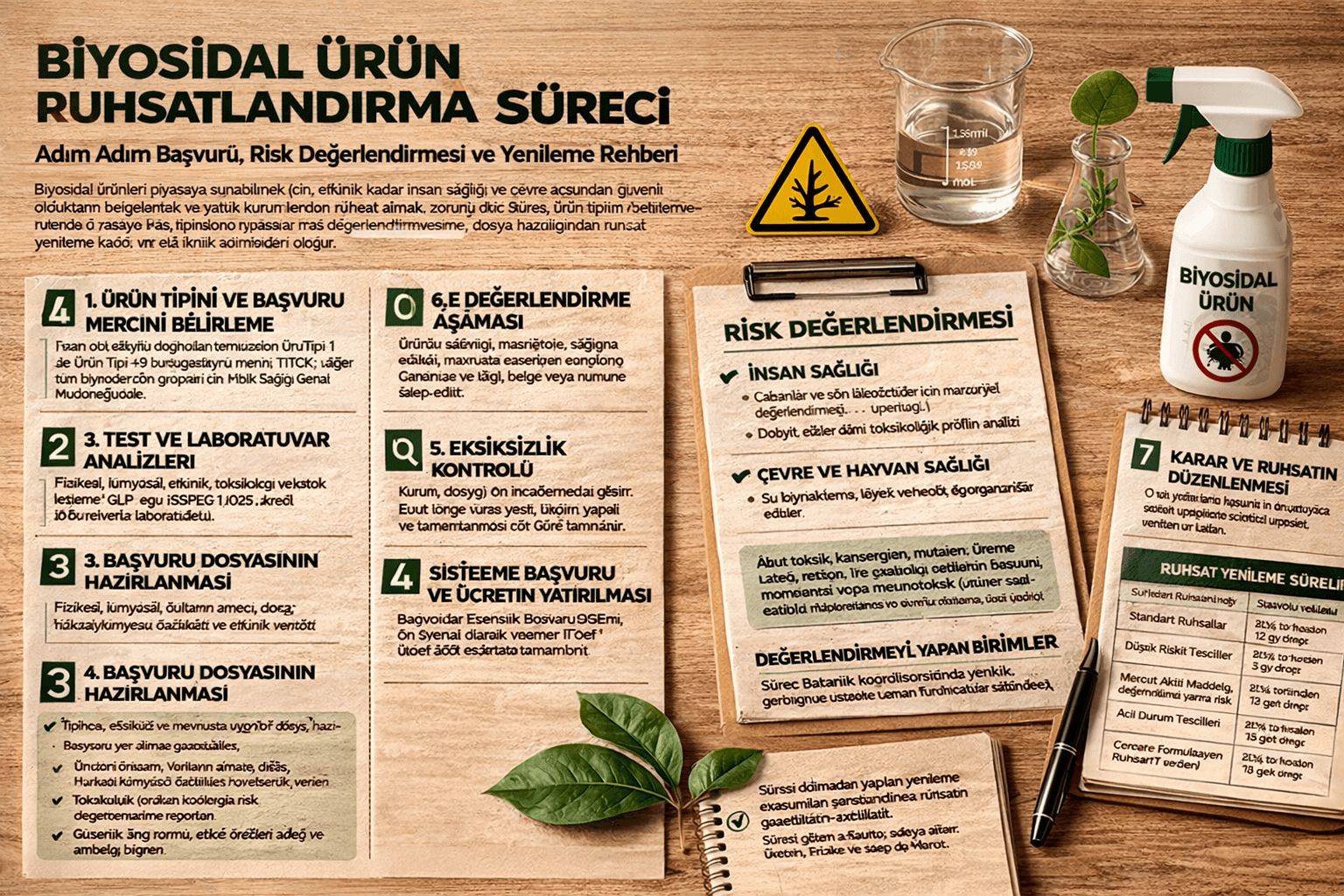
Biocidal Product Authorisation in Turkey: Applications, Risk Assessment, and Renewal
Biocidal product authorisation is not a paperwork exercise disguised as compliance. If the product-type (PT) storyline, laboratory evidence, and exposure narrative do not line up, the dossier usually stalls at completeness or substantive review. This article gives import managers, brand owners, and regulatory teams a shared map—from first filing thoughts to renewal.
We avoid fabricated “hard deadlines” and focus on the questions authorities actually ask. That keeps planning honest for supply chain and sales.
Product type and competent authority
Choosing the PT and respecting formulation boundaries
The claimed effect (surface disinfection, preservation, vector control, etc.) must match the active substances and use settings. A wrong PT cascades into the wrong test battery and exposure model—expensive to fix later.
National authority and electronic workflow
The Turkish system is Ministry-of-Health-led, with electronic submission as the operational norm. Data that lives only in PDFs but not in the portal workflow is hard to defend under audit.
Testing and laboratory work
Phys-chem, efficacy, and (where needed) toxicology/ecotoxicology endpoints must be consistent with the PT and the use scenario. A report “on file” is not enough if the method, sample definition, and interpretation disagree. Aligning the lab plan early with testing services usually saves rework.
What the dossier actually carries
Expect composition and supplier transparency, manufacturing/import traceability, label and instructions, exposure scenarios, reasonable environmental release assumptions, and—where relevant—reuse of REACH/KKDIK datasets in a biocidal-appropriate way. Map overlaps early with KKDIK / chemical compliance to avoid duplicate work.
E-submission, fees, and process hygiene
Portal submission is also a discipline problem: correct annexing, readable attachments, and fee steps completed on time. Tariffs can change; finance and RA should share a simple checklist.
Completeness check and substantive evaluation
Completeness comes first: inconsistencies are cleared before the scientific dialogue deepens. Substantive questions typically cluster around exposure assumptions, efficacy claims, and environmental endpoints. Slow answers directly hit launch plans.
Human health risk assessment
Professional, consumer, and indirect exposure routes need explicit scenarios. Toxicology and exposure must speak the same language; otherwise no meaningful risk characterisation emerges—and conditions of use become guesswork.
Environment and ecotoxicology
Generic statements do not replace data or justified read-across. Endpoints and release estimates should reflect where the product is actually used. Where data gaps exist, the justification must be review-ready, not decorative.
Risk outcomes: conditions, restrictions, and labelling
Risk management is often about right user, right dose, right warning—not automatic withdrawal. Labels and training aids are part of the authorisation package. Keep marketing copy aligned with SDS / GBF preparation.
Validity, ECHA/BPR context, and portfolio realism
Product authorisation duration should be read together with active substance review cycles. EU BPR/ECHA developments are an early-warning system for portfolios you maintain in Turkey—track them like a risk register, not a footnote.
Renewal timing and the cost of missing it
Renewal is rarely “resubmit the old PDF.” It can require refreshed studies, revised exposure arguments, and label updates. Late renewals tend to produce thin files—and thin files attract questions.
Closing note
Biocidal authorisation is cross-functional: regulatory, quality, supply, and sales must share one storyline. Pier Compliance can support you on biocidal product authorisation—from PT/dossier design and test strategy to renewal planning. If you want a grounded conversation, use the contact page and we’ll outline sensible next steps.
Frequently asked questions
- Where should a biocidal product authorisation application be submitted?
- In Turkey the process sits under the Ministry of Health track, with electronic submission through the national portal as the standard workflow. Labels, claims, and technical content should read as one consistent story.
- Which documents are required in a biocidal product dossier?
- Expect composition and sourcing, phys-chem and efficacy evidence, toxicology/ecotoxicology arguments, exposure scenarios, label and instructions for use, and traceability/quality rationale. Depth varies by product type and use pattern.
- Why is risk assessment mandatory for biocidal products?
- Non-target humans, animals, and environmental compartments can be exposed. Authorisation is built around a benefit-risk judgement, so datasets and scenarios are the backbone of the file—not optional annexes.
- How is the validity period of a biocidal authorisation determined?
- It depends on the product type, the active substance status/review cycle, and the national decision text. EU-level BPR/ECHA timelines often influence real-world portfolio planning for Turkish registrations.
- What happens if the renewal application is missed?
- Once validity lapses, placing product on the market, importing, and downstream distribution become legally fragile. Renewal should include data updates and label revisions where needed—late sprints usually create weak submissions.
